 WonksAnonymous
Editorial Policy
How WonksAnonymous chooses topics, separates facts from calculations and assumptions, labels data, uses AI and handles links.
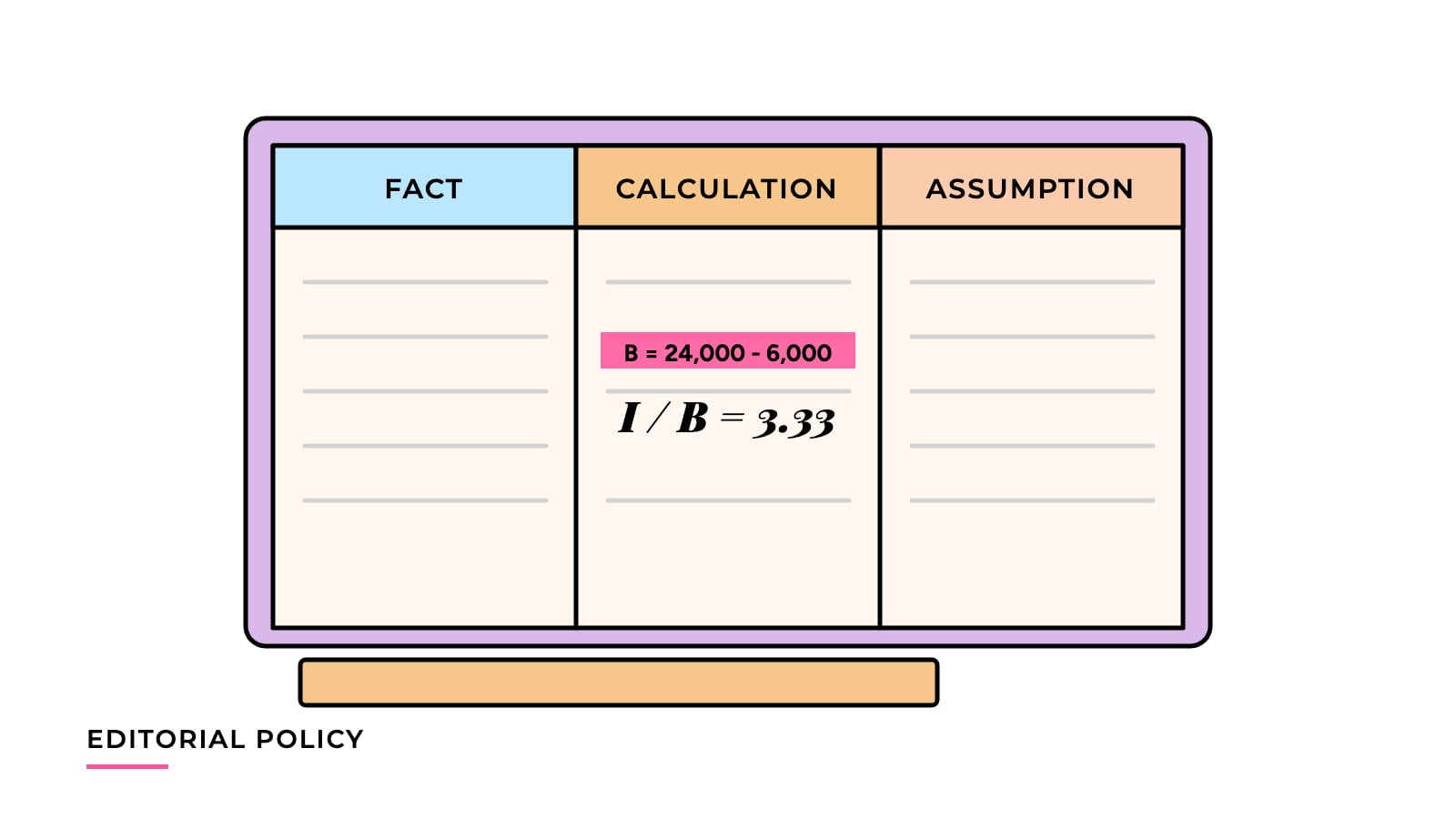
This page explains how we decide what to publish and how we keep facts, calculations and assumptions apart. It covers all analysis on the site.
Start from a reader question
Every piece starts from a decision a reader faces, such as whether a machine will pay back at current volume. We don’t start from a keyword or a link target.
Evidence first
Before writing, we decide what evidence the piece needs. If we can’t find it, we narrow the question or say what is unknown. A stated gap is more useful to a plant manager than a confident answer built on a guess.
We prefer primary sources, such as statistical agencies and standards bodies, to summaries of them. When we cite an outside source, we name it and link to the original so you can check the figure where it started.
Facts, calculations and assumptions
Every piece keeps three kinds of statement apart and labeled:
- Sourced facts, with the source named.
- Our own calculations, with the arithmetic shown.
- Scenario assumptions, which a reader can change.
Worked examples state their inputs. We don’t write “studies show” or “manufacturers save on average” unless we have real data and can state the method.
A worked illustration
The payback example from Automation Payback, ROI and TCO shows what the separation looks like. Replace the inputs with the plant’s own figures before using the payback.
- Fact: simple payback is defined as the up-front investment divided by the annual cash benefit, and it exists only when that benefit is above zero.
- Assumptions: an installed investment of $60,000, cash labor savings of $24,000 a year, and new maintenance and energy of $6,000 a year. Replace these inputs with the plant’s own figures.
- Calculation: annual benefit B = 24,000 - 6,000 = $18,000. Payback = 60,000 / 18,000 = 3.33 years, and 3.33 x 12 = 40 months.
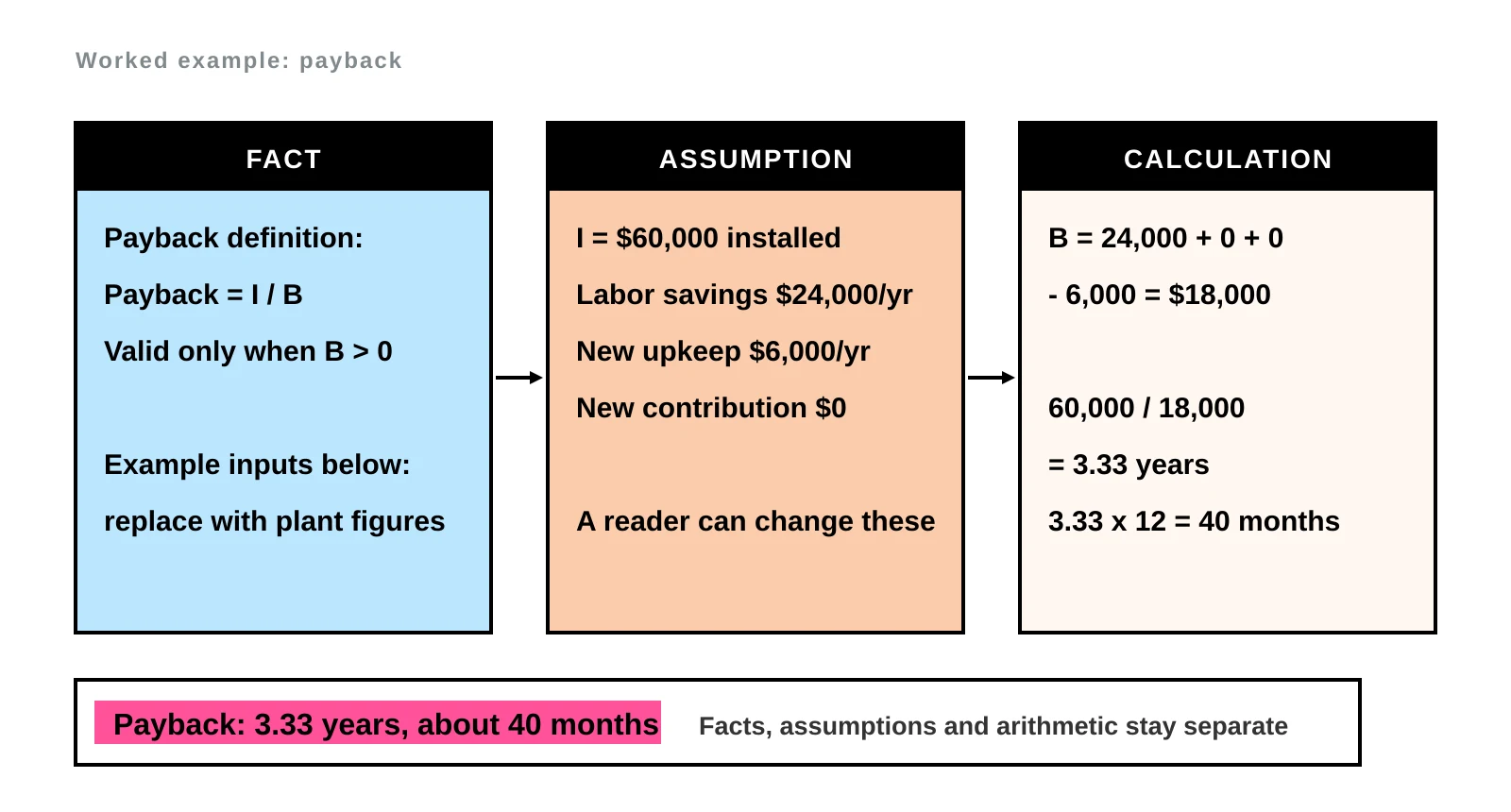
If the labor figure came from a published source, such as a federal compensation survey, it would move to the fact column with the source named. The calculation would stay the same. Only the label on the input would change.
How a piece is checked before publishing
Before an article goes live, an editor goes through this list.
- Recompute every number from the stated inputs, and check that rounding is consistent. Years multiplied by 12 must equal the months shown.
- Check every link, internal and external, and confirm that each external link goes to the original source.
- In the text and in any figure, say that a worked example’s inputs are replaced with the plant’s quotes or measured figures before the result is used.
- Check each claim against its source, and remove any claim we cannot trace.
- Remove unsupported generalizations, such as statements about what manufacturers typically do.
A piece that fails any step goes back for revision. If an error gets through anyway, the Corrections page explains what we do.
What we will not publish
- Fake surveys, or statistics presented without a method.
- Invented case studies, customer stories or testimonials.
- AI-generated images presented as real photographs of factories, equipment or test results.
- Supplier rankings or “best machine” lists. Our Disclosures page says why.
Comparing cost structures is different, and it is the point of the site. The Production Economics hub has examples, such as how cost per good pack is built from stated inputs.
Supplier and related-party data
Data from suppliers, or from businesses we have a commercial relationship with, is labeled and kept apart from data from other sources. See Disclosures.
What models can and cannot do
Our models compare options under stated assumptions. A payback figure in an article is a starting point for your own numbers, not a forecast of your result, and none of it replaces financial, tax, legal, safety or engineering review. A conclusion is allowed to go against buying equipment.
Updates
Our calculations rest on stated assumptions, and assumptions go stale. When wages, prices or rules change enough to alter a result, we update the article and add a note at the end saying what changed.
Dates
Articles do not display a publication date. When a change affects a number, formula or conclusion, a note at the end of the article describes it. We never present new writing as if it had been published earlier.
Expert review
A reviewer’s name appears on a piece only when a named, qualified person actually reviewed it. Otherwise we don’t imply review. The default byline is “WonksAnonymous Editors”, and it means the editors, not a credentialed outside expert.
How we use AI
We use AI tools for research, outlining, organizing sources, code and formatting. They do not replace fact-checking, original data, permissions or human review. We do not publish AI-generated images of factories, customers or test results as if they were real, and illustrations on this site are labeled as illustrations.
Links
We link when a link helps you verify a fact or make a decision. Paid links use rel=“sponsored”, purely promotional placements use rel=“nofollow”, and user content uses rel=“ugc”. A commercial relationship with a linked business is disclosed next to the link. See Disclosures.
Corrections
If we get something wrong, we fix it and say so. Corrections explains how to report an error and how we record changes.
For an overview of what the site covers, see the About page.