 WonksAnonymous
About WonksAnonymous
WonksAnonymous publishes evidence-led analysis and worked cost models on production costs, automation investment and supply-chain decisions.
WonksAnonymous is a research publication on the economics of work, production and automation. We try to help you answer three questions about any equipment decision: why invest, how to cost it, and when it is worth doing.
What we publish
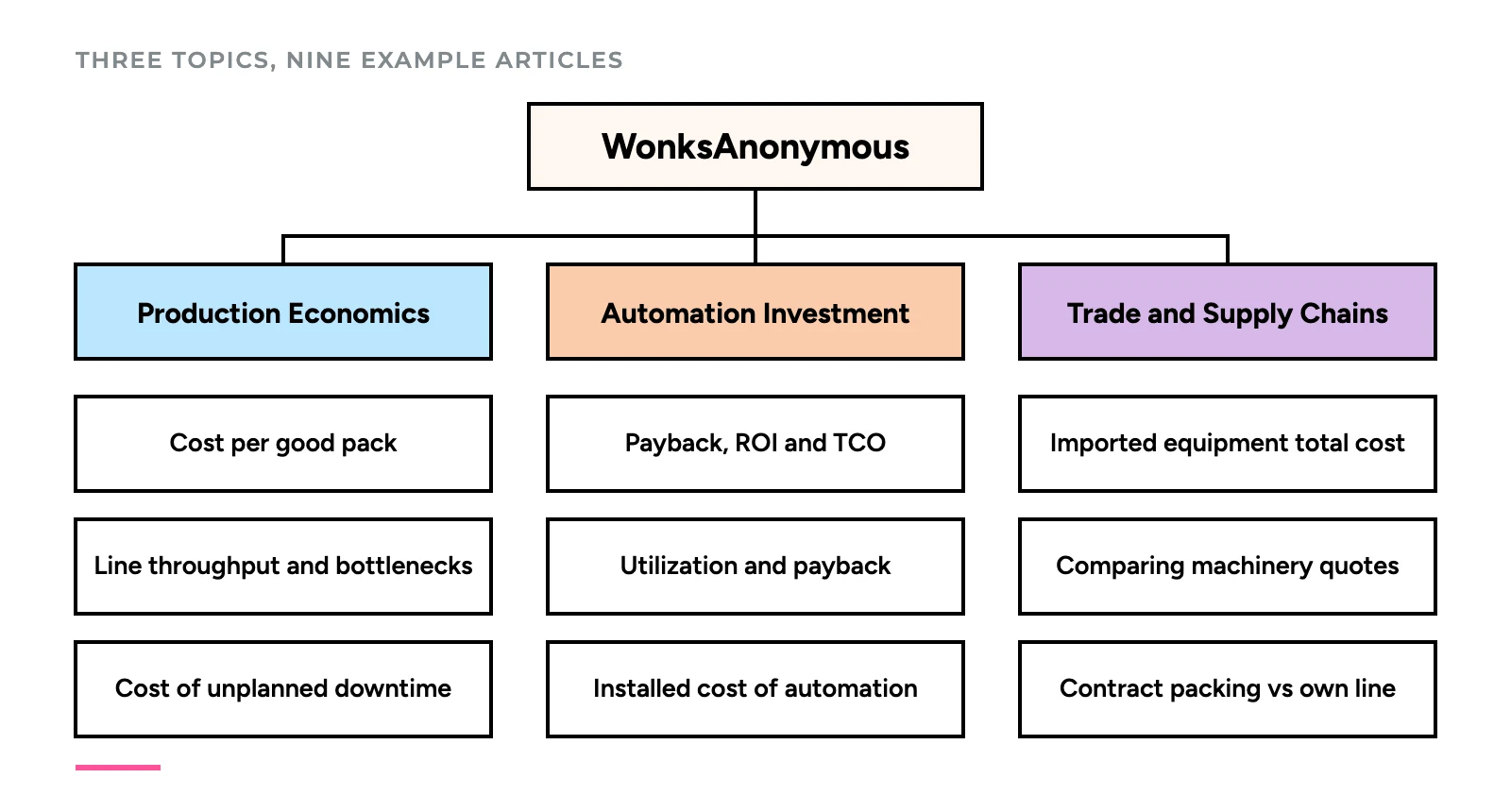
The site is about the costs and trade-offs of running production, mostly packaging and other repeatable manufacturing work. There are three topics, each with its own hub page.
- Production Economics: unit costs, effective output, labor, bottlenecks, downtime and scrap.
- Automation Investment: payback, total cost of ownership, installed cost and utilization.
- Trade and Supply Chains: landed equipment costs, import logistics and spare parts.
Everything we’ve written is listed on the analysis page.
What a typical piece looks like
Analysis articles share a layout, so you can jump to the part you need. Each one opens with the decision a reader faces and a short answer, then defines its terms, shows the formula and works through an example with the arithmetic on the page.
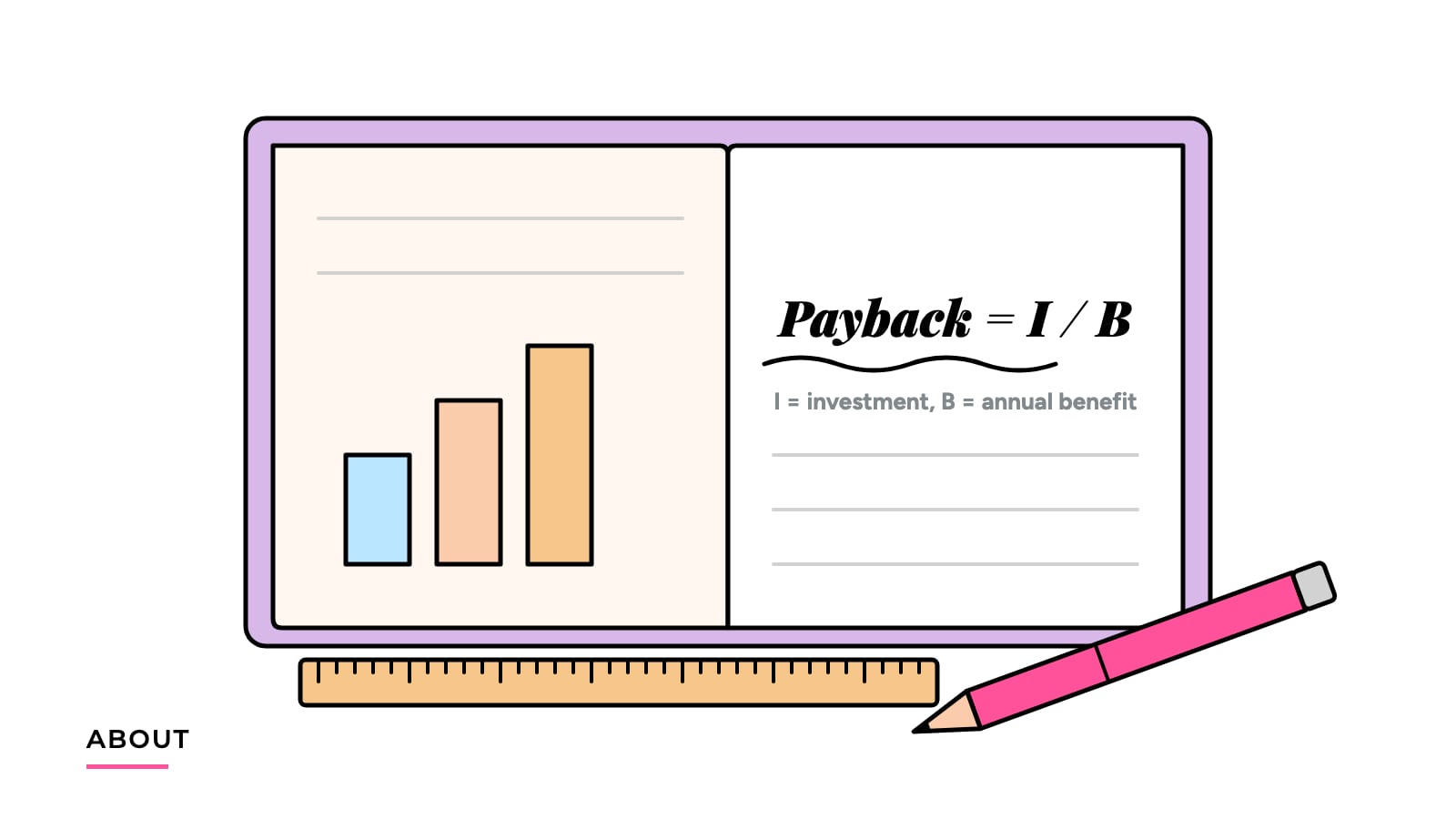
Take Automation Payback, ROI and TCO: What Each Metric Tells You. It asks which of three metrics to trust when someone proposes a machine. Its answer is that each metric answers a different question, so name the question first. The payback formula is short:
Payback (years) = I / B, only when B > 0
A worked example uses an installed investment of $60,000, cash labor savings of $24,000 and new maintenance and energy of $6,000, so B = $18,000 per year. Then 60,000 / 18,000 = 3.33 years, or about 40 months. Replace the inputs with the plant’s own figures before treating 40 months as its payback.
After that, the piece covers when the conclusion changes and which mistakes are common, points to three related articles, and closes with its assumptions and limits. That last section lists what the model leaves out, such as taxes, financing and the time value of money.
Questions we answer
Here are the questions readers bring most often, each paired with the article that answers it.
- Which metric should I trust when a proposal quotes payback, ROI or TCO? See Automation Payback, ROI and TCO.
- What costs sit outside the machine price? See The True Installed Cost of Packaging Automation.
- How do running hours change payback? See How Equipment Utilization Changes Automation Payback.
- Are freed hours the same as cash savings? See Labor Savings Versus Redeployment.
- What does a pack really cost once scrap is counted? See Cost per Good Pack.
- Why did a faster machine not raise output? See Why Faster Machines Do Not Always Increase Line Output.
- What does an hour of unplanned downtime cost? See Measuring the Cost of Unplanned Production Downtime.
- How do small batches change packaging cost? See Small Batches and Frequent Changeovers.
- At what volume does semi-automatic or full automation win? See Manual, Semi-Automatic or Fully Automatic Packaging?
- Are two quotes really comparable? See Comparing Packaging Machinery Quotes on a Like-for-Like Basis.
- What changes when equipment is imported? See Imported Equipment Costs Beyond the Factory Price.
- Did the machine deliver what the business case promised? See The 90-Day Post-Installation Review.
The full list, including rollstock versus premade pouches and contract packing versus owning a line, is on the analysis page.
What we will add next
Calculators and data pages are in preparation and will be published only after testing. We will check each one against worked examples whose answers we have worked out by hand, and each will state its formulas and limits. We aren’t giving dates, because a tool that ships before it is tested is worse than none.
Who it is written for
Owners of small and mid-sized manufacturers keep coming back to one question: does current order volume justify buying a machine? We write cost models and risk scenarios for that decision.
Operations and production managers want to know how cycle time, changeovers, scrap and downtime change real output. Finance and purchasing leads want to know what else sits behind a quote and how much the result depends on each assumption.
Writers and researchers need figures with defined terms and methods. We state definitions and limits so a number can be cited accurately.
What we do and do not do
We show the formula and the inputs. When automation doesn’t pay, we say so. A conclusion such as “current volume does not justify the machine” is a normal result here.
We are not a product catalog, a quote service, a university or nonprofit think tank, or an independent rating agency. We do not rank suppliers. Every worked example shows its arithmetic, so you can rerun it with your own volumes, wages and downtime.
Who writes it
Pieces are published under the byline “WonksAnonymous Editors”. A reviewer’s name appears only when a qualified person has reviewed the piece.
The rules on commercial relationships, supplier data and sponsorship are on the Disclosures page.
The name and this address
Links from other websites show that around 2008 and 2009 this address hosted a blog about economics and public policy, written by other people. The current publisher has no connection to those authors. The archive page explains what we are doing about the old addresses.
How we work
The Editorial Policy covers how we choose evidence, label numbers and use AI tools. If you find a mistake, see Corrections. To reach the editors, use the Contact page.