 WonksAnonymous
Absorption Costing vs Variable Costing: Overhead
Compare absorption costing vs variable costing on fixed manufacturing overhead, GAAP and tax rules, capacity caps, and why inventory swings shift profit.
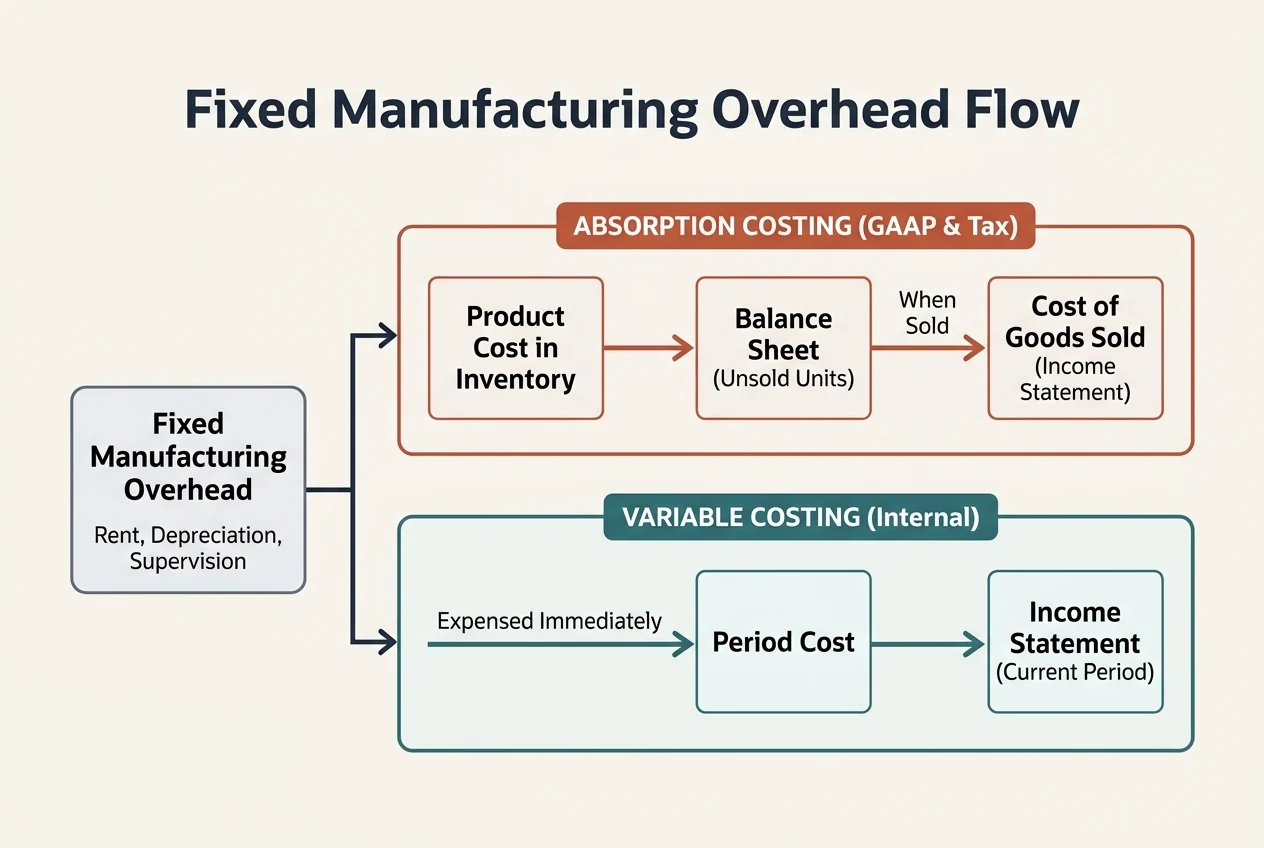
Absorption costing vs variable costing comes down to how a manufacturer treats fixed manufacturing overhead. Absorption costing assigns fixed factory overhead to each produced unit as an inventory product cost until the unit is sold, as required by GAAP and tax law. Variable costing expenses fixed factory overhead immediately as a period cost for clearer internal decisions.
Both methods treat direct materials, direct labor, and variable manufacturing overhead identically as inventoriable product costs, and both treat selling and administrative expenses as period costs. The accounting divergence occurs solely when production and sales volumes differ, causing fixed manufacturing overhead to accumulate in ending inventory or release from beginning inventory.
What is meant by absorption costing in manufacturing?
Absorption costing, also called full costing, assigns direct materials, direct labor, variable manufacturing overhead, and fixed manufacturing overhead to every unit produced. Because all factory conversion costs attach to work in process and finished goods inventory, fixed overhead stays on the balance sheet as an asset until the finished units are sold.
Variable costing, also called direct costing or marginal costing, assigns only direct materials, direct labor, and variable manufacturing overhead to product cost. Under variable costing, fixed manufacturing overhead is never capitalized into inventory value; instead, the full fixed overhead pool is expensed against revenue in the period incurred.
Scroll horizontally to see all columns.
| Cost component | Absorption costing (full costing) | Variable costing (direct or marginal costing) | Timing of income statement recognition |
|---|---|---|---|
| Direct materials | Product cost (inventory) | Product cost (inventory) | Matched to revenue in COGS when finished goods sell |
| Direct labor | Product cost (inventory) | Product cost (inventory) | Released from inventory into COGS at the point of sale |
| Variable manufacturing overhead | Product cost (inventory) | Product cost (inventory) | Recognized in cost of goods sold when units are sold |
| Fixed manufacturing overhead | Product cost (allocated to inventory) | Period cost (excluded from inventory) | Deferred until sale under absorption; expensed immediately under variable |
| Selling and administrative expenses | Period cost (excluded from inventory) | Period cost (excluded from inventory) | Expensed in the period incurred under both methods |
Which indirect production costs enter inventory versus period expense?
Federal manufacturing inventory rules under 26 CFR 1.471-11 draw a bright operational line between production costs and non-manufacturing period costs. Direct production costs consist of materials that become an integral part of or are consumed for specific units plus direct labor identifiable with those units, including basic compensation, overtime, vacation, holiday pay, shift differentials, and payroll taxes.
Indirect production costs split into fixed and variable pools by how they respond to volume at a given capacity. Fixed indirect production costs—such as factory rent, building and machinery property taxes, depreciation, and plant management—do not vary significantly with output. Variable indirect production costs—such as indirect materials, factory janitorial supplies, and production utilities—vary directly or nearly directly with production volume.
Under 26 CFR 1.471-11, indirect costs that must enter inventoriable production cost whenever incident to manufacturing include repairs, maintenance, utilities, rent, indirect labor and supervisory wages, indirect materials and supplies, non-capitalized tools, and quality control and inspection. By contrast, marketing, advertising, selling, distribution, interest, research and experimental expenses, income taxes, and corporate general and administrative expenses are excluded from inventory cost. For a detailed line-item boundary between factory pools and corporate overhead, see the manufacturing versus non-manufacturing overhead formula.
Does GAAP or tax law require absorption costing or variable costing?
Only absorption costing complies with U.S. GAAP and U.S. federal tax law for external reporting. Absorption costing satisfies the GAAP expense recognition principle by matching fixed manufacturing overhead to revenue in the period the inventory sells. Variable costing is not acceptable for GAAP financial statements or tax returns because it expenses fixed factory overhead before the units are sold.
Across major accounting and tax jurisdictions, external inventory valuation converges on full absorption principles with statutory guardrails:
Scroll horizontally to see all columns.
| Reporting regime | Required inventory method | Treatment of fixed manufacturing overhead | Key compliance boundary |
|---|---|---|---|
| U.S. GAAP external reporting | Absorption costing only | Capitalized into inventory; expensed in COGS upon sale | Grounded in the accrual expense recognition principle |
| U.S. federal tax (IRC Section 471 and 263A) | Full absorption and uniform capitalization | Direct and indirect production costs capitalized into inventory basis | Exempts qualifying small taxpayers under Section 448(c); changes require Form 3115 |
| UK GAAP (FRS 102 Section 13) | Absorption costing at normal capacity | Allocated to stock based on average expected normal capacity | Idle capacity is expensed immediately; high output reduces unit allocation |
| Internal managerial reporting | Variable costing or dual ledger | Expensed as a lump-sum period cost below contribution margin | Used internally for CVP analysis, budgeting, and incremental pricing |
For U.S. federal income taxes, 26 CFR 1.471-11 mandates the full absorption method under Section 471 so inventory accounting conforms to best accounting practices and clearly reflects income. IRS Publication 538 confirms that inventory valuation must conform to generally accepted accounting principles and satisfy the uniform capitalization rules of Section 263A (alongside Section 475 mark-to-market rules where applicable). Under uniform capitalization, producers must capitalize direct costs and part of indirect costs into the basis of produced property and recover them through cost of goods sold upon sale, rather than deducting them currently.
One statutory carve-out applies to smaller operations: IRS Publication 538 notes that a small business taxpayer meeting the gross receipts test under Section 448(c) and not classified as a tax shelter is exempt from the uniform capitalization rules. Once an inventory accounting method is established, changing that method requires filing Form 3115.
How do the absorption costing and variable costing formulas differ?
The unit product cost formula differs by exactly one term: allocated fixed manufacturing overhead per unit. Under variable costing, unit product cost sums direct materials, direct labor, and variable manufacturing overhead per unit. Under absorption costing, unit product cost adds allocated fixed manufacturing overhead per unit to that variable production base.
In plain algebraic form, the two unit-cost equations are:
- Variable unit product cost = Direct materials per unit + Direct labor per unit + Variable manufacturing overhead per unit
- Absorption unit product cost = Direct materials per unit + Direct labor per unit + Variable manufacturing overhead per unit + Fixed manufacturing overhead per unit
- Fixed manufacturing overhead per unit = Total fixed manufacturing overhead divided by the chosen capacity or activity denominator
Acceptable absorption allocation systems under 26 CFR 1.471-11 include the manufacturing burden rate method and the standard cost method. To see how line-level direct inputs scale before overhead enters the equation, review the variable cost formula with packaging line examples.
Normal capacity and practical capacity ceilings
A common plant accounting error is dividing total fixed overhead by actual output during a slow quarter, which inflates unit inventory value and hides idle-machine losses on the balance sheet. Accounting and tax standards block that distortion by anchoring fixed overhead allocation to normal or practical capacity.
Under FRS 102 Section 13 as detailed in HMRC Business Income Manual BIM33135, fixed production overheads are allocated to inventory on the basis of normal capacity—the production expected to be achieved on average over a period of time. Low production does not increase the fixed overhead allocated per unit; instead, unabsorbed fixed overhead from idle facilities is expensed immediately. Conversely, during periods of high production, it may be necessary to reduce per-unit fixed overhead so inventory is not measured above actual cost. Variable production overheads remain allocated based on actual facility use.
U.S. tax regulations provide a parallel framework through the practical capacity concept in 26 CFR 1.471-11, where the ratio of actual output to practical capacity (capped at 100 percent) determines the share of fixed indirect production costs eligible for inventory capitalization, while the unallocated idle-capacity balance is deductible in the year incurred. The regulation illustrates this with a stamping plant:
Scroll horizontally to see all columns.
| Practical capacity step (26 CFR 1.471-11 illustration) | Quantity or ratio | Accounting treatment |
|---|---|---|
| Theoretical line rate and operating schedule | 50 units/hour across 1960 hours/year | Establishes peak theoretical output before downtime |
| Ordinary repair and maintenance allowance | 5 percent downtime reduction | Converts theoretical output to 93,100 units of practical capacity |
| Actual period production | 76,000 units produced | Absorbs 81.6 percent of fixed indirect production costs into inventoriable cost |
| Unallocated idle capacity share | Remaining portion below 93,100 units | Deducted immediately as a period expense rather than capitalized |
| Ending finished goods inventory | 7,600 units on hand (10 percent of output) | Retains 10 percent of the 81.6 percent absorbed fixed overhead pool and 10 percent of variable indirect costs |
This structure ensures that underutilized machinery does not masquerade as higher-value inventory on the balance sheet.
How does the income statement differ under absorption and variable costing?
Absorption costing uses a traditional functional income statement that deducts full cost of goods sold from sales to show gross margin, then deducts selling and administrative expenses. Variable costing uses a contribution-margin format that deducts all variable costs from sales to show contribution margin, then deducts total fixed manufacturing overhead and fixed non-manufacturing costs in full.
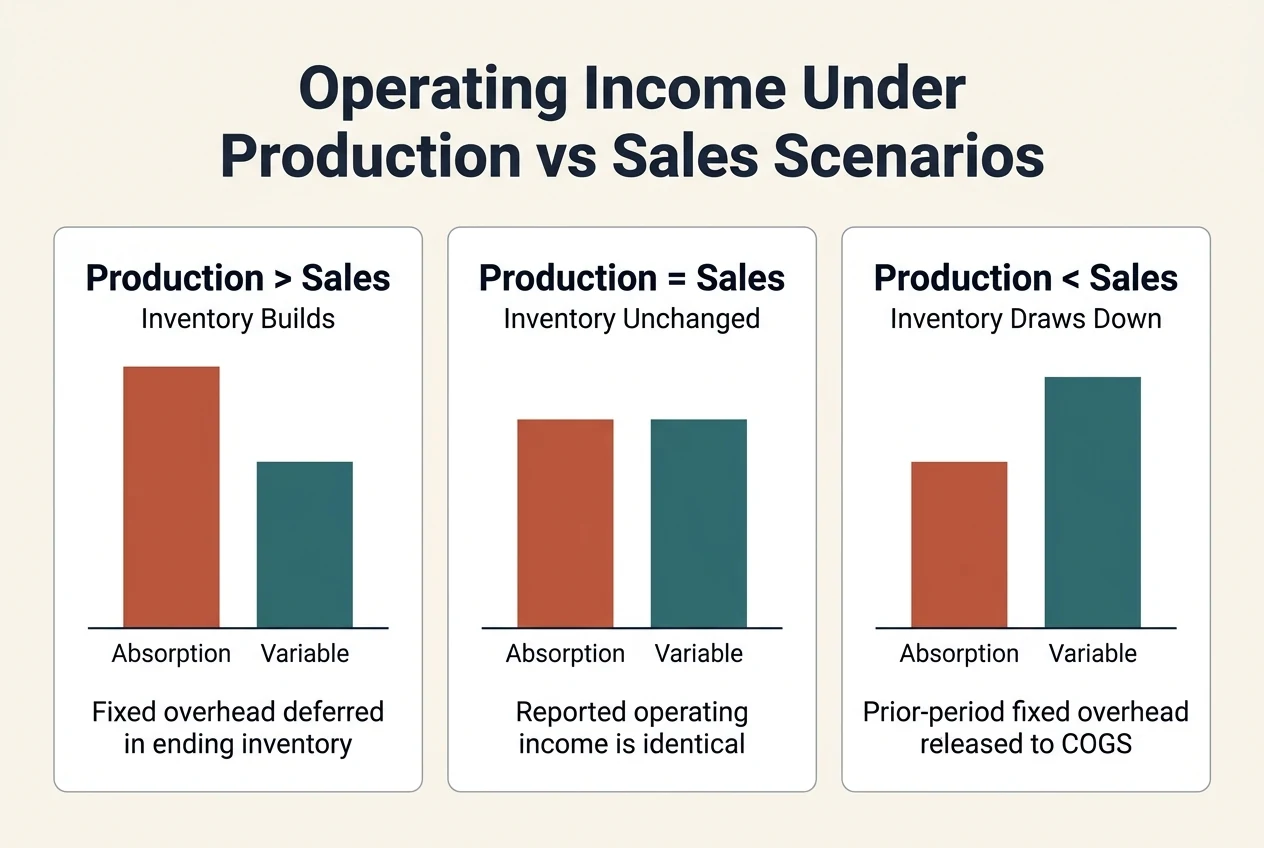
Whenever production volume differs from sales volume, reported operating income diverges by the exact amount of fixed manufacturing overhead added to or released from inventory during the period.
Scroll horizontally to see all columns.
| Production vs sales regime | Ending inventory change | Fixed manufacturing overhead movement | Operating income comparison |
|---|---|---|---|
| Production equals sales | No net change in finished goods units | All current fixed overhead is expensed under both methods | Absorption income equals variable income |
| Production exceeds sales | Ending inventory increases | Absorption costing defers part of current fixed overhead in ending inventory | Absorption income is higher than variable income |
| Sales exceed production | Ending inventory decreases | Absorption costing releases prior-period fixed overhead from beginning inventory into COGS | Variable income is higher than absorption income |
Reconciling the profit gap across production and sales cycles
To trace the deferral mechanism, consider a period in which a plant sells 8,000 units and holds 2,000 units in finished goods inventory at year-end. Under absorption costing, only the fixed overhead attached to the 8,000 sold units flows into cost of goods sold, while the fixed overhead attached to the 2,000 unsold units stays deferred on the balance sheet as ending inventory until a future period when those units sell. Under variable costing, the entire period’s fixed manufacturing overhead hits the income statement immediately, producing lower current-period operating income by exactly the deferred fixed overhead sitting inside those 2,000 units.
When the plant later sells down that backlog—selling more units than it manufactures—the pattern reverses. Absorption costing pulls prior-period fixed overhead out of beginning inventory into cost of goods sold alongside current-period production costs, pushing absorption operating income below variable operating income.
Across both build and drawdown cycles, the exact reconciliation identity holds:
- Absorption operating income minus variable operating income = Fixed manufacturing overhead deferred in ending inventory minus fixed manufacturing overhead released from beginning inventory
Over the long run, as produced goods eventually sell through, the cumulative income difference between variable vs absorption costing approaches zero. The divergence is purely a timing difference in when fixed factory expenses reach the income statement. To connect finished goods inventory flows back to work-in-process balances, follow the cost of goods manufactured and WIP reconciliation guide.
Why can absorption costing distort production decisions, and how does marginal costing compare?
Relying on absorption gross margin for internal volume or bonus decisions creates an incentive to overproduce. Building extra unsold inventory spreads fixed factory overhead across more units, lowering allocated fixed cost per unit and parking fixed expenses in ending inventory—which boosts reported absorption net income even when customer sales are flat.
How year-end overproduction inflates absorption profit
Under absorption costing, reported net income responds to both sales volume and production volume. If a plant manager whose bonus is tied to operating profit runs extra shifts near year-end without matching customer orders, total fixed overhead spreads across a larger denominator, lowering fixed overhead per unit. Because fixed overhead follows the produced units into finished goods inventory rather than cost of goods sold, absorption profit rises immediately while cash spending on materials, labor, and warehousing increases without adding revenue. In extreme inventory builds, absorption profit can even move in the opposite direction from unit sales.
Where variable or marginal costing fits internal control
Marginal costing is synonymous with variable costing in managerial accounting. Because fixed manufacturing overhead is isolated as a period expense below contribution margin, variable costing keeps reported operating income aligned with sales volume rather than warehouse buildup.
Management teams pair GAAP absorption ledgers with internal variable costing reports for four recurring decisions:
- Cost-volume-profit (CVP) analysis: Separating variable and fixed overhead directly supplies contribution margin without stripping fixed overhead out of product cost.
- Flexible budgeting: Within a relevant production range, variable production costs scale cleanly with actual output while fixed overhead stays visible as a dedicated budget line.
- Incremental order evaluation: Variable unit cost aligns closely with current out-of-pocket production outlays when assessing an extra batch or special run.
- Segment and product-line appraisal: Removing allocated common fixed overhead prevents arbitrary overhead spreads from distorting product and customer margins.
After installing automated equipment that shifts plant costs from direct labor to fixed depreciation, reviewing overhead allocation drivers becomes essential alongside variable costing reports; see the manufacturing overhead allocation after automation analysis, the production economics collection, and the complete analysis index.
Frequently asked questions
Is marginal costing the same as variable costing?
Yes. In managerial accounting, variable costing is also called direct costing or marginal costing. All three terms refer to the same method: assigning direct materials, direct labor, and variable manufacturing overhead to inventory while expensing fixed manufacturing overhead in full during the period incurred.
Why do absorption and variable costing report the same profit when production equals sales?
When a manufacturer sells the exact quantity of units produced in a period, finished goods inventory neither builds nor draws down. All fixed manufacturing overhead incurred during the period flows through cost of goods sold under absorption costing and through period expenses under variable costing, resulting in identical net income.
Does variable costing violate GAAP if used for internal dashboards?
No. Variable costing is disallowed for external GAAP financial statements and U.S. tax returns, but companies routinely run variable costing internally for CVP modeling, flexible budgets, and incremental decisions while maintaining GAAP-compliant absorption valuations for external reporting.
How does idle plant capacity affect absorption unit cost?
Under both HMRC BIM33135 (FRS 102 Section 13) and the practical capacity concept in 26 CFR 1.471-11, low production must not increase the fixed overhead allocated per unit. Fixed overhead tied to idle capacity is expensed immediately in the period incurred rather than capitalized into ending inventory.
Can a manufacturer switch inventory costing methods for tax purposes without IRS consent?
No. According to IRS Publication 538, once an inventory valuation method is established, changing the method of accounting for inventory requires filing Form 3115 with the IRS.
Sources
- Legal Information Institute (Cornell Law School) — 26 CFR 1.471-11: Inventories of manufacturers
- Internal Revenue Service (IRS) — Publication 538: Accounting Periods and Methods
- HM Revenue & Customs (GOV.UK) — Business Income Manual BIM33135: Stock valuation, cost and overheads
- OpenStax — Principles of Accounting, Volume 2: Managerial Accounting, Section 6.5: Compare and Contrast Variable and Absorption Costing