 WonksAnonymous
Cost of Goods Manufactured Formula: A Packaging WIP Reconciliation
Build a manufacturing-cost statement from raw-material usage, labor, overhead and WIP, then reconcile COGM to costed finished-goods receipts.
Treating every dollar spent on a packaging line this month as completed production can overstate the cost received into finished goods. The cost of goods manufactured formula is COGM = beginning work in process + direct materials used + direct labor + manufacturing overhead − ending work in process; reconcile that result to the cost of completed lots transferred into finished goods.
The existing fixed, variable and total cost formulas explain an operating-cost model and explicitly exclude COGM. This page supplies the inventory bridge. OpenStax’s manufacturing cost-flow chapter follows costs through raw materials, WIP and finished goods; the monthly packaging ledger below is an original assumed example, not a company’s accounts.
Reconcile raw-material consumption before entering direct materials
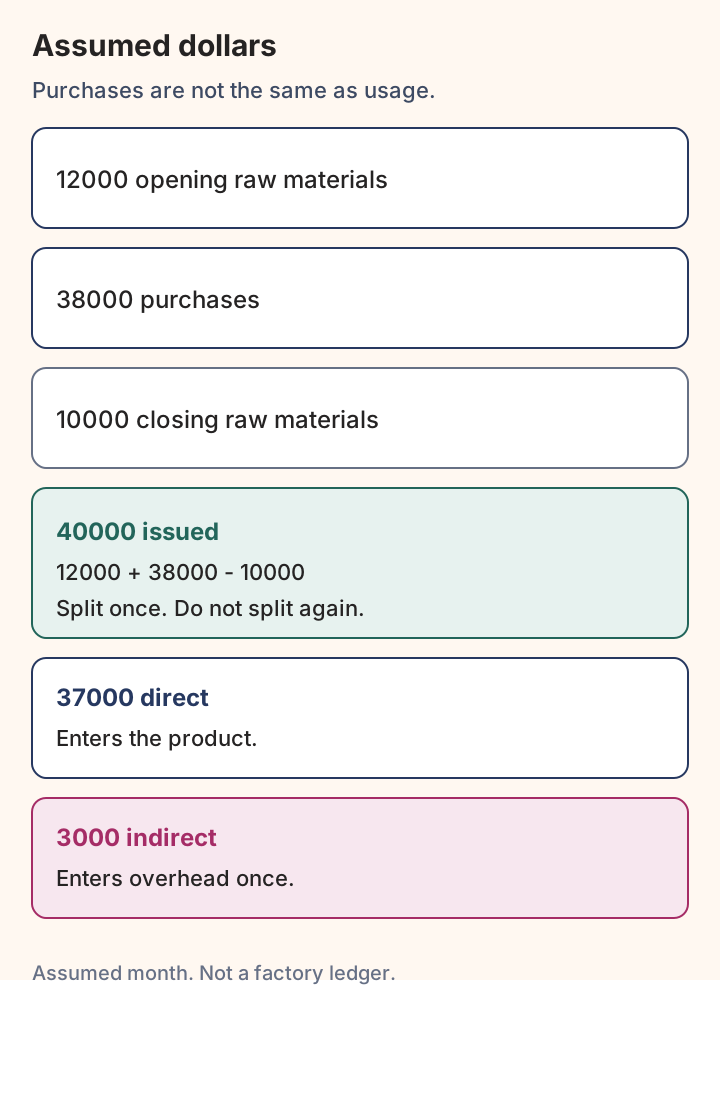
Calculate what left raw-material inventory, then separate direct issues from indirect issues. Purchases alone are not consumption.
Total materials issued = beginning raw materials + net purchases − ending raw materials
Direct materials used = total materials issued − indirect materials issued
This simple bridge assumes no other raw-material movements. In real records, identify returns, write-offs and transfers separately rather than forcing them into direct usage. Use the same valuation basis and cut-off for balances and movements.
The assumed monthly figures below are inventory costs in dollars, not physical pack counts or equipment prices:
Scroll horizontally to see all columns.
| Raw-material statement, assumed | Dollars |
|---|---|
| Beginning raw-material inventory | $12,000 |
| Add net purchases received in the month | $38,000 |
| Materials available | $50,000 |
| Less ending raw-material inventory | ($10,000) |
| Total material issues to production | $40,000 |
| Less indirect materials assigned to overhead | ($3,000) |
| Direct materials used | $37,000 |
Assumed worked example: direct materials used = $12,000 + $38,000 − $10,000 − $3,000 = $37,000.
The $3,000 has not vanished. It enters the overhead total below exactly once. OpenStax’s product-cost chapter separates materials traced to products from indirect materials assigned through manufacturing overhead. In a packaging ledger, use the issue record to decide which branch each material follows.
An unused roll still in the material store belongs in the closing raw-material balance. A roll already issued to an unfinished job requires the job’s material and production records. Its cost cannot also remain in the store balance simply because the finished packs have not been received.
Build the manufacturing-cost statement on one basis
Add this month’s manufacturing inputs, then adjust for WIP carried across the month boundary. Beginning WIP carries earlier costs into the schedule; ending WIP retains the cost of work still unfinished.
This assumed example uses actual manufacturing costs throughout. The overhead pool is $18,000: $3,000 indirect materials, $6,000 indirect factory labor, $4,000 manufacturing utilities and $5,000 factory equipment depreciation. Direct labor is a separate $24,000. No applied-versus-actual overhead variance or other inventory adjustment is assumed.
Scroll horizontally to see all columns.
| Manufacturing-cost statement, assumed month | Dollars |
|---|---|
| Direct materials used, from material statement | $37,000 |
| Direct labor added this month | $24,000 |
| Manufacturing overhead added this month | $18,000 |
| Total current manufacturing costs | $79,000 |
| Add beginning WIP | $9,000 |
| Total cost to account for in WIP | $88,000 |
| Less ending WIP | ($11,000) |
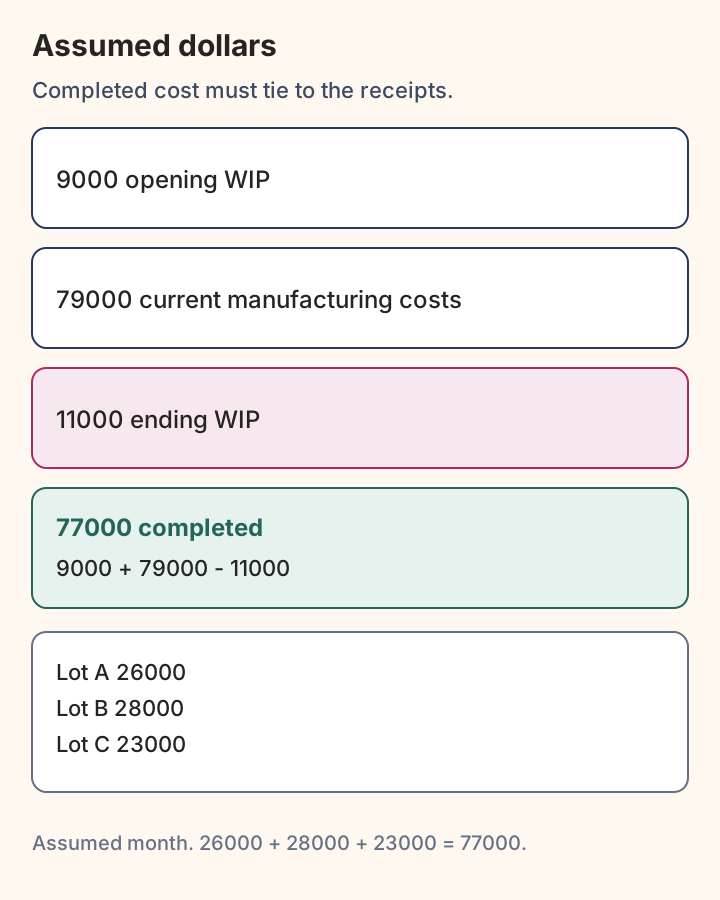
| Cost of goods manufactured | $77,000 |
Current manufacturing cost = DM used + DL + manufacturing OH
COGM = beginning WIP + current manufacturing cost − ending WIP
Assumed worked example: COGM = $9,000 + ($37,000 + $24,000 + $18,000) − $11,000 = $77,000.
Current manufacturing cost exceeds COGM by $2,000 because WIP increased by $2,000. That difference alone says nothing about whether the line ran efficiently. It may reflect work begun late in the month; investigate the job status rather than declaring a cost saving or loss from the inventory movement.
Where a plant applies overhead using a predetermined rate, use the overhead posted to WIP and document the variance treatment separately. Do not insert actual overhead into a schedule whose job balances use applied overhead. The overhead-allocation analysis explains the rate and allocation-base decision; this statement needs the resulting posted amount on a consistent basis.
Tie COGM to completed-lot receipts
The $77,000 must agree with costed production transfers into finished goods, not merely with a pallet count. In the assumed receipt log, completed lots A, B and C carry $26,000, $28,000 and $23,000 respectively. Their sum is $77,000. The unfinished-job listing carries $6,000 and $5,000, totaling the $11,000 closing WIP.
WIP residual = beginning WIP + current manufacturing costs
               − completed transfers − ending WIP
Receipt difference = COGM − sum of costed completed-lot receipts
Assumed tie-out: $9,000 + $79,000 − ($26,000 + $28,000 + $23,000) − $11,000 = $0 WIP residual; $77,000 − $77,000 = $0 receipt difference.
The production-transfer entry is a debit to finished-goods inventory and a credit to WIP for the same manufacturing cost. An internal transfer into another unfinished processing department is not yet a receipt into finished goods. Match job or lot ID, completion status, posting date and cost before accepting the tie-out.
For the assumed ledger, an unexplained nonzero difference is a reason to inspect receipts and journals. A zero residual is necessary, but it cannot prove that the underlying job valuation or completion status is correct. An omitted job on both sides can still leave a balanced statement.
Keep COGM, COGS and operating cost distinct
Use the measure that matches the flow being checked. COGM measures completed manufacturing cost; the other measures answer different questions.
Scroll horizontally to see all columns.
| Measure | What it follows | Dominant Failure Mode & Prevention |
|---|---|---|
| Current manufacturing cost | This period’s direct materials used, direct labor and manufacturing overhead | Raw-material purchases replace actual usage; reconcile the material account first. |
| COGM | Cost leaving WIP for completed finished goods | Ending WIP is omitted or added; reconcile unfinished jobs and subtract their closing cost. |
| Cost of goods sold, COGS | Manufacturing cost leaving finished goods as goods are sold | Every completed pack is treated as sold; reconcile finished-goods balances and sales issues. |
| Operating cost per good pack | Defined operating-cost numerator divided by accepted packs | An inventory transfer value is substituted for the operating-cost numerator; state the cost scope and denominator. |
The next inventory bridge, before separately identified adjustments, is:
Unadjusted COGS = beginning finished goods + COGM − ending finished goods
Assumed downstream example: $14,000 beginning finished goods + $77,000 COGM − $17,000 ending finished goods = $74,000 unadjusted COGS. This assumes no other finished-goods movements. The $3,000 increase in finished goods explains why COGS differs from COGM; it is not another subtraction in the WIP statement.
Direct/indirect classification and fixed/variable behavior are separate questions. Factory depreciation can belong in manufacturing overhead even though it is fixed within an operating range. Conversely, a responsive cost subtotal alone cannot supply the manufacturing statement. Use the variable cost formula packaging-line examples for run-volume behavior and cost per good pack for its explicitly defined operating measure.
Rules of Thumb for closing the statement
Use these arithmetic thresholds as checks, not as industry benchmarks:
- If total materials issued minus direct and indirect issues is not $0, reconcile the material ledger before entering DM. In the assumed month: $40,000 − $37,000 − $3,000 = $0.
- If the WIP residual or receipt difference is not $0 before display rounding, investigate missing lots, cut-off dates, duplicate postings and inconsistent cost bases. Do not change closing WIP merely to clear the difference.
- If ending WIP exceeds beginning WIP, COGM is below current manufacturing cost by that increase, assuming no other WIP movements. Here $11,000 − $9,000 = $2,000.
- If reported ending WIP exceeds beginning WIP plus current additions, the simple schedule produces negative COGM. Resolve missing movements, reversals or valuation problems before interpreting it as production cost.
Collect the opening and closing material and WIP balances, net material receipts, issue classifications, labor postings, overhead postings, unfinished-job listing and costed finished-goods receipts for one period. For partially completed continuous production, the closing WIP value needs a supported costing method and completion assessment; this reconciliation does not supply those inputs. The Production Economics guide places the statement alongside the operating measures used to investigate production.
Methods and sources
Updated October 2026. WonksAnonymous Editors prepared this AI-assisted explanation. Accounting relationships were checked against OpenStax, Principles of Accounting, Volume 2: Managerial Accounting, sections 4.2 and 4.3, accessed October 19, 2026. All ledger balances, monthly additions, lot costs and numerical tie-outs are original assumed teaching examples. No factory accounts, equipment prices or industry benchmark are represented.