 WonksAnonymous
Labor Savings Versus Redeployment: Avoiding False Payback Claims
How to separate cash labor savings from freed hours in an automation business case, so a payback claim does not count wages the company will still pay.
A business case for a machine often says “this saves 800 hours of labor.” That can mean two different things: cash that stops leaving the company, or hours that people now spend on something else. A payback period built on the wrong reading can look sound and still never show up in the accounts.
Freed hours are a physical result. Cash savings are a financial one, and the two overlap only when payroll or other labor spending actually goes down. Count the first as capacity, the second as savings, and keep them on separate lines. The same test applies to scrap, energy, downtime and the other savings that sit beside labor in a business case.
Hours freed are not dollars saved
An automation project reduces the labor hours a task needs. That is a fact about the process. Whether it is also a fact about the budget depends on what the company does next.
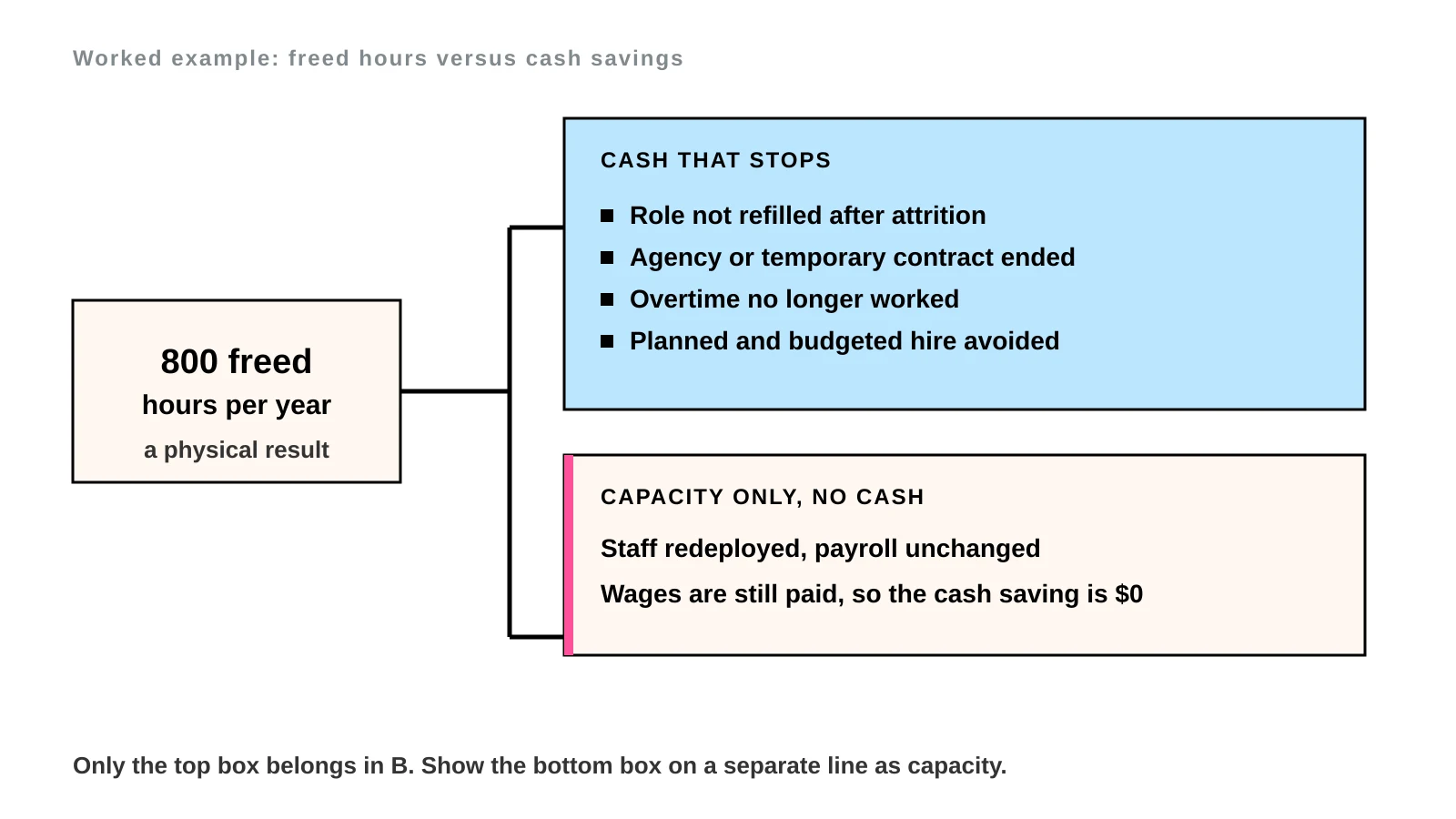
Hours turn into cash savings only through a specific mechanism:
- A role is not refilled after natural attrition (retirement, resignation).
- An agency or temporary labor contract ends or is no longer booked.
- Overtime that was being worked is no longer worked.
- A planned hire is no longer needed. This counts as avoided cost only if the hire was genuinely planned and budgeted.
If people move to other work and total labor spending doesn’t change, the cash saving is zero, because the wages are still paid. The freed capacity may still be valuable, but it isn’t cash and shouldn’t enter the payback arithmetic as if it were.
What an hour costs the employer
An hour costs the employer more than the wage on the pay stub. The U.S. Bureau of Labor Statistics describes total compensation as wages and salaries plus benefits, including paid leave, insurance, retirement and legally required benefits (BLS, Employer Costs for Employee Compensation: Concepts).
For a role that really goes away, use the fully loaded cost per hour, not the hourly wage, and take it from your own wage rates, benefit costs and agency invoices. In the example below, $30 per hour is the fully loaded cost to replace with the plant’s own wage, benefit and agency rates. It is not a BLS figure.
Cash labor saving per year = hours of spending that actually stops × cost per hour of that spending
The payback formula with a separate labor line
The payback model here is the simple cash version used across this site.
I = installed investment (equipment, transport, installation, training, site work)

B = actual cash labor saving
  + other actual cash savings
  + realizable, non-duplicated contribution from additional orders
  - new annual cash costs (maintenance, energy, consumables, added labor)

Simple payback (years) = I / B,  only if B > 0
Payback (months) = years × 12
If B is zero or negative, the model has no positive payback. That isn’t “0 years” or a negative number of years. The honest statement is that, on these inputs, the investment doesn’t pay back in cash.
Worked example: the same 800 hours, three outcomes
Worked example. Replace each input with a quote or a measured figure from the plant before using the result.
The setup: a packing station where two packers spend part of their week packing by hand. The machine frees 800 packing hours per year. Fully loaded cost is $30 per hour (not a BLS figure; use the plant’s own wage, benefit and agency rates), installed investment I is $60,000, and new maintenance and energy cost $6,000 per year.
On paper, the freed hours are worth 800 × $30 = $24,000. That is the labor line in the example from Automation Payback, ROI and TCO, which gives B = $24,000 - $6,000 = $18,000 and a payback of 40 months. The question is when that $24,000 is real.
Scroll horizontally to see all columns.
| A: Agency hours end | B: Staff redeployed | C: Overtime avoided, rest redeployed | |
|---|---|---|---|
| Freed hours per year | 800 | 800 | 800 |
| Hours where spending stops | 800 | 0 | 400 |
| Cost per hour of that spending | $30 | not applicable | $45 (overtime at 1.5 × $30) |
| Cash labor saving | 800 × $30 = $24,000 | $0 | 400 × $45 = $18,000 |
| New maintenance and energy | -$6,000 | -$6,000 | -$6,000 |
| B (net annual cash benefit) | $18,000 | -$6,000 | $12,000 |
| Simple payback | $60,000 / $18,000 = 3.33 years | No positive payback | $60,000 / $12,000 = 5.0 years |
| Payback in months | 3.33 × 12 = 40 months | Not applicable | 5.0 × 12 = 60 months |
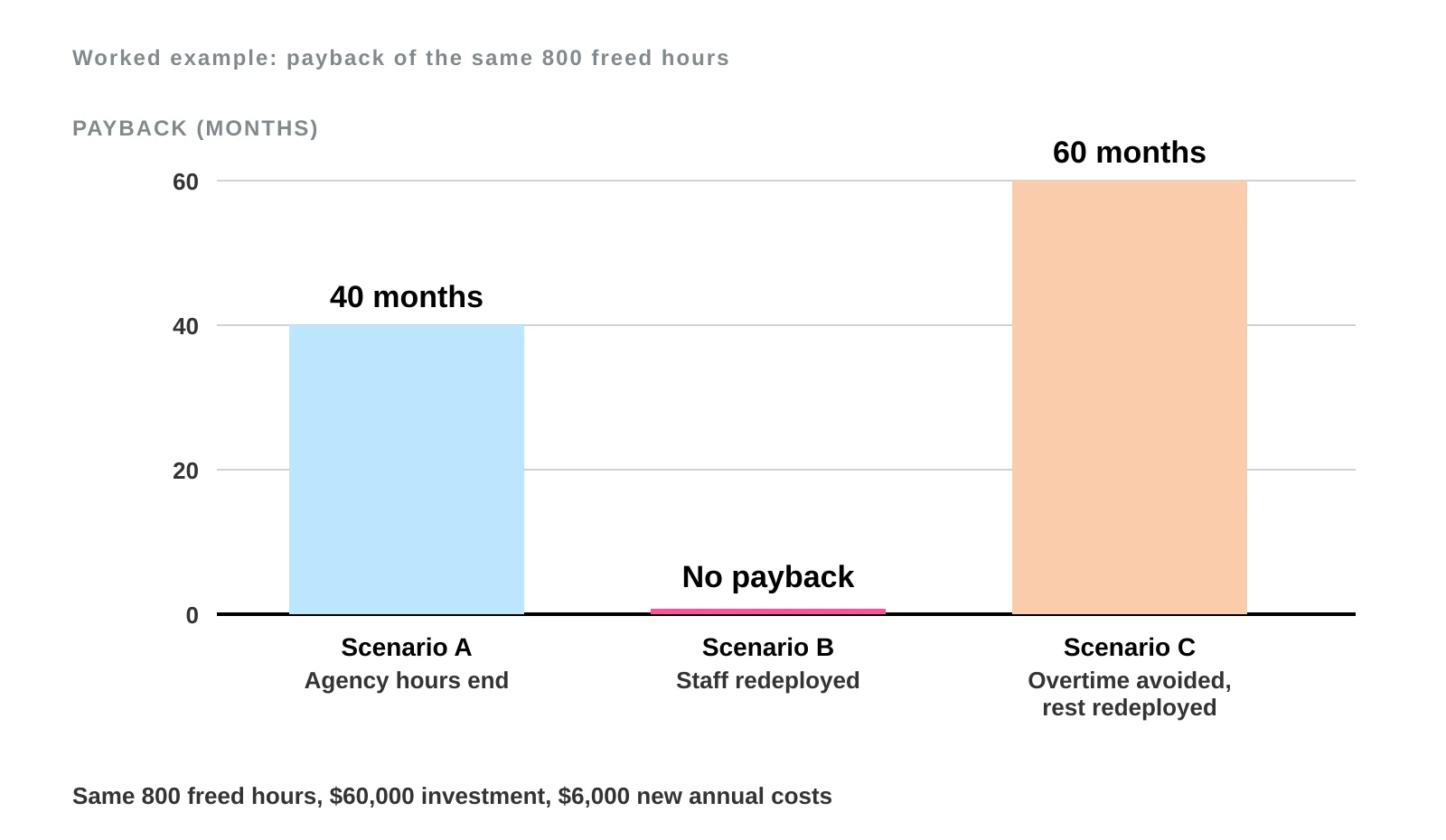
In scenario A, the 800 hours were worked by agency temps who are no longer booked. Spending stops, so the saving is $24,000 and B = $18,000. Payback is $60,000 / $18,000 = 3.33 years, or 40 months.
In scenario B, the hours belonged to permanent staff who move to other work. There is no open vacancy and no cut in payroll, so the cash saving is $0 and B = $0 - $6,000 = -$6,000. With B below zero, the model gives no positive payback.
In scenario C, 400 of the freed hours replace overtime that would otherwise have been paid at time-and-a-half ($30 × 1.5 = $45 per hour). The saving is 400 × $45 = $18,000, and the other 400 hours are redeployed with no saving. B = $18,000 - $6,000 = $12,000, and payback is $60,000 / $12,000 = 5.0 years, or 60 months.
The same 800 freed hours give a 40-month payback, no payback, or a 60-month payback, depending on what happens to the spending. A business case that writes “$24,000 labor savings” without naming the mechanism is claiming scenario A whether or not it holds.
When freed hours do have value
Scenario B doesn’t make the project worthless. The cash model finds no saving, but redeployed people may produce value elsewhere, and that value has to be shown on its own terms.
Freed hours can go to additional orders. Count the contribution from those orders (revenue less variable costs), not the wages of the people, and include it only if demand exists, downstream capacity can take the extra volume and delivery allows. Don’t count the same margin twice.
They can also cover work that would otherwise need overtime or a hire. That is a cash mechanism, as in scenario C, and it should be named and dated.
Or they can go to improvement work such as quality, training or maintenance. That may be useful but is hard to convert to cash, so treat it as a qualitative benefit unless it reduces a measurable cost such as scrap (see Cost per Good Pack).
If the extra orders aren’t real yet, the contribution line is zero. A prospect is not an order.
Savings other than labor: the same test applies
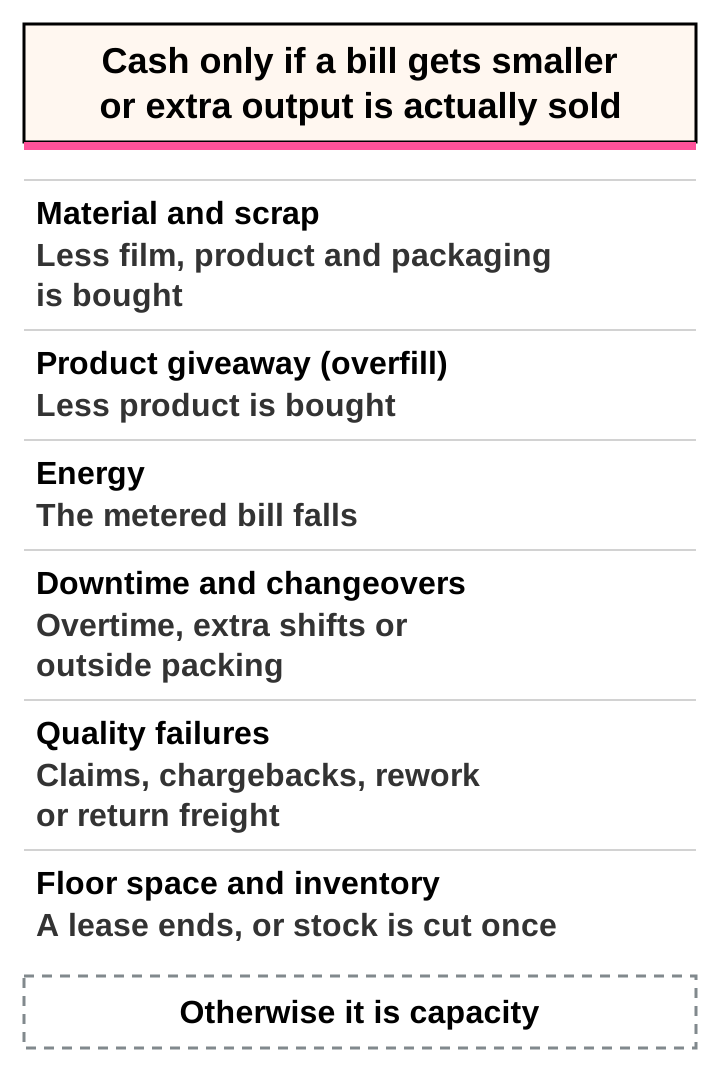
The formula above has a line for “other actual cash savings”, and it needs the same discipline as the labor line. A business case usually lists several sources of savings beyond labor. The six below are this article’s grouping, not a standard list, but they cover the claims that most often appear next to labor in an automation proposal.
The test is unchanged: a saving is cash only if a bill gets smaller or extra output is actually sold. Otherwise it is capacity, and it goes on its own line.
Scroll horizontally to see all columns.
| Source of saving | Cash when | Capacity only when | Evidence to keep |
|---|---|---|---|
| Material and scrap | Fewer packs are run for the same good output, so less film, product and packaging is bought | The same material is bought and the extra good packs go into stock nobody has ordered | Purchase volumes, reject counts over a fixed run |
| Product giveaway (overfill) | Less product is bought for the same number of packs, or the product saved is sold in additional packs | The saved product has no buyer | Fill-weight records before and after |
| Energy | The metered bill falls | The machine uses as much energy as it saves, or more | Meter readings, not nameplate ratings |
| Downtime and changeovers | Overtime, extra shifts or outside packing that were bought to cover lost hours stop | The line simply has more idle time | Shift and overtime records |
| Quality failures | Customer claims, chargebacks, rework or return freight that were being paid fall | The failures were rare or never cost money | Claim and credit-note records |
| Floor space and inventory | A lease ends, or stock is cut once and the cash released is counted once | The space stays empty or the stock is rebuilt | Lease terms, inventory records |
Two of these need care. Energy can go the wrong way: a machine replacing manual work usually adds load, which is why the worked example carries a $6,000 line for new maintenance and energy. Count an energy saving only when measured total energy cost falls for comparable output, including any load the new equipment adds. Inventory reduction is a one-time release of cash, not an annual saving: putting it into B every year counts it again in each year of the payback.
Worked example for a line of 1,000,000 good packs a year. Replace the volume, reject rates and the $0.10 material loss with the line’s own records. A line needs 1,000,000 good packs a year. Material lost per rejected pack is $0.10. The machine cuts the reject rate from 3 percent to 1 percent.
Packs run at 3% rejects = 1,000,000 / 0.97 = 1,030,928
Packs run at 1% rejects = 1,000,000 / 0.99 = 1,010,101
Fewer packs run         = 1,030,928 - 1,010,101 = 20,827
Material saved          = 20,827 x $0.10 = about $2,083 a year
That $2,083 is cash if purchases fall with it. The machine time freed by running 20,827 fewer packs is capacity, worth something only if an order fills it, and then it is counted as contribution, not as a second scrap saving. Cost per Good Pack shows how scrap, speed and labor combine into one unit cost.
Labor the project adds
Automation often creates new labor needs, and they reduce the saving: a technician or a more skilled operator, extra maintenance hours, a higher pay grade for the machine operator.
Say the machine needs 100 extra technician hours per year at $40 per hour. That is $4,000. In scenario A, B falls from $18,000 to $24,000 - $6,000 - $4,000 = $14,000, and payback becomes $60,000 / $14,000 = 4.29 years, about 51 months.
Checklist for an honest labor line
For each source of savings in the business case, write down:
- The role, contract or overtime category the saving relies on.
- The date the spending stops.
- The mechanism: attrition, contract end, overtime reduction or avoided hire.
- Who signs off that the spending will not be replaced (finance, operations or the budget owner).
- For an avoided hire, the evidence that it was planned and budgeted before the project.
- New labor added by the project, with cost per year.
- Freed hours that do not become cash, on a separate line from cash savings.
- For each non-labor saving, the bill or purchase that gets smaller, and the record that will show it.
The sign-off step matters most. It is easy to agree that hours are freed and much harder to agree that a budget line will go down. After installation, check which savings became cash in the 90-day post-installation review. The installed-cost side has its own checklist in The True Installed Cost of Packaging Automation.
When the conclusion changes
- If the plant is growing and freed people absorb work that would otherwise require new hires, the avoided cost is real. Document it as a planned hire.
- If contract terms or local rules delay the end date of agency labor, the saving starts late.
- If the work frees small fractions of several people’s time, no role can be removed, and the cash saving is probably zero even though the hours are real.
How a company handles redeployment is its own decision, with legal, contractual and human considerations of its own. This article doesn’t recommend cutting jobs. Its point is accounting honesty: if people stay on payroll, the saving isn’t in cash, and a payback claim shouldn’t say it is. More on this subject is under Automation Investment.
Keep reading
- Automation Payback, ROI and TCO: What Each Metric Tells You: the definitions behind the payback formula used here.
- How Equipment Utilization Changes Automation Payback: how volume and uptime change B and the payback period.
- Cost per Good Pack: A More Useful Measure Than Nameplate Speed: a unit-cost view that takes in labor, scrap and output quality.
Assumptions and limits
- Replace the 800 freed hours, the $30 fully loaded cost, the $60,000 investment, the $6,000 annual costs and the overtime premium with the plant’s own records before treating the payback as a decision figure.
- The model is a simple payback with stable annual cash flows. It ignores taxes, financing, the time value of money, ramp-up and residual value.
- Each scenario counts a full year of steady-state savings. In practice, contract end dates and attrition produce partial first-year effects.
- One-time people costs (severance, retraining, recruitment) are not included.
- Replace the scrap example’s volume, reject rates and $0.10 material loss per rejected pack with the line’s own records.
- Contribution from additional orders is excluded from all three scenarios. If you add it, check demand, downstream capacity and double counting first.
- The model is for comparison. It isn’t financial, legal or safety advice, and employment law in your location is a separate question.
Sources
- U.S. Bureau of Labor Statistics, Employer Costs for Employee Compensation: Concepts