 WonksAnonymous
MACRS Depreciation: GDS vs ADS & Conventions
MACRS depreciation recovers business property basis under GDS or ADS using Appendix B asset classes, averaging conventions, and IRS Appendix A rate tables.
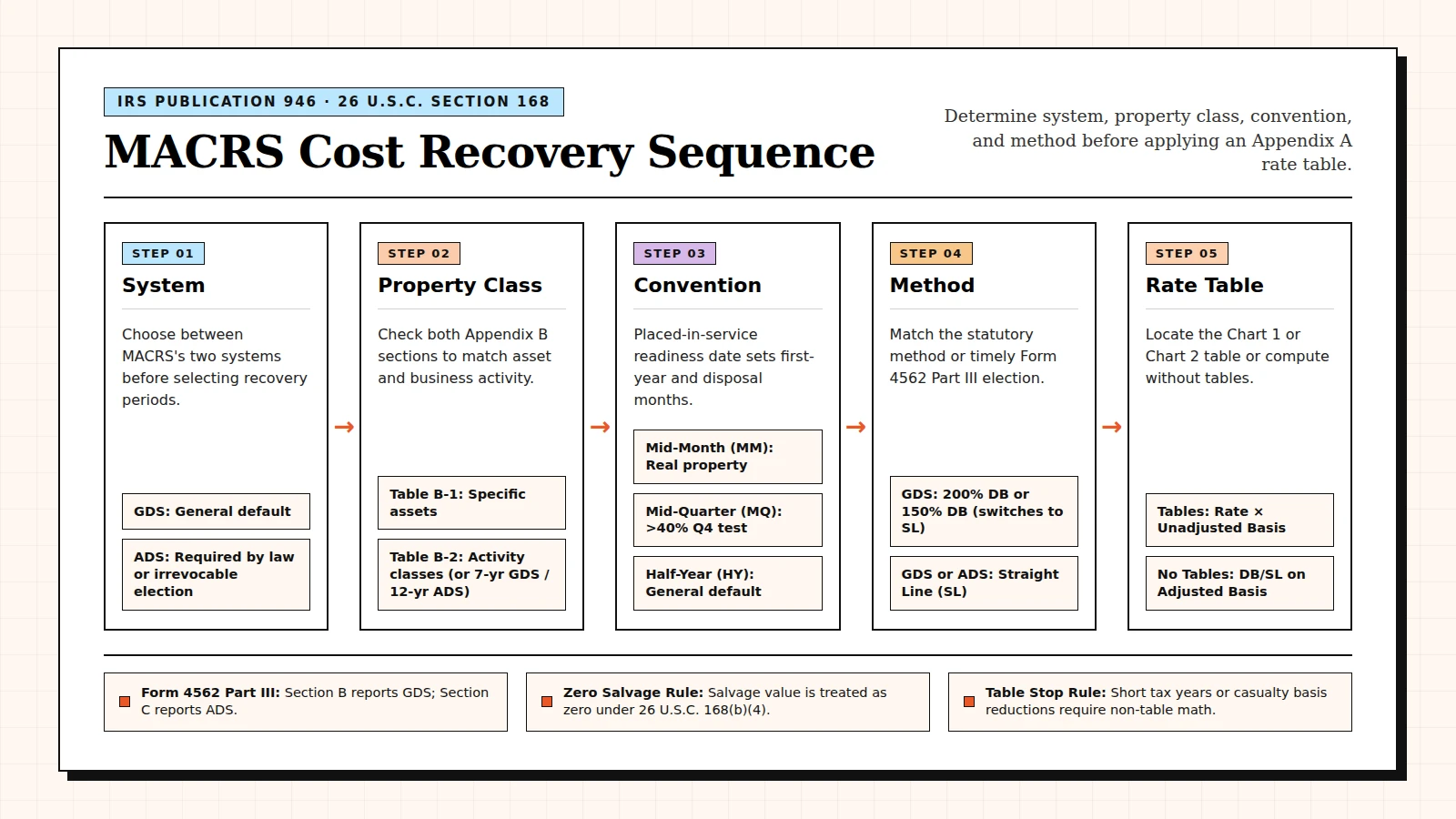
The Modified Accelerated Cost Recovery System (MACRS) recovers the basis of most tangible business and investment property placed in service after 1986 through two systems: the General Depreciation System (GDS) and the Alternative Depreciation System (ADS). Taxpayers must generally use GDS unless federal law specifically requires ADS or the taxpayer elects ADS. Under IRS Publication 946, figuring a MACRS deduction follows a fixed order: determine the depreciation system, property class, placed-in-service date, basis amount, recovery period, averaging convention, and depreciation method, then apply an Appendix A percentage table to unadjusted basis or compute the deduction without the tables on adjusted basis.
When using an IRS percentage table, multiply the property’s unadjusted basis by the table rate each recovery year without subtracting MACRS depreciation claimed in earlier years. Original basis is first reduced by items such as any section 179 deduction, amortization, and any special depreciation allowance, and any later basis adjustment other than depreciation or a separately depreciated addition—such as a deductible casualty loss—stops table eligibility and switches remaining recovery years to adjusted basis.
Within our Analysis library and the Automation Investment reading guide, this reference starts after a capital asset’s cost basis has been separated from operating spend under CapEx vs OpEx for Production Equipment, and supplies the federal tax-recovery rules that feed multi-year after-tax cash-flow sheets in ROI Calculation in Excel for Equipment CapEx. None of the rules summarized here prepares Form 4562, establishes a tax return position, or replaces financial, tax, legal, safety, or engineering review.
How does MACRS depreciation work for business property?
Under 26 U.S.C. section 168(a), the federal depreciation deduction for tangible property is determined by combining three statutory elements: the applicable depreciation method, the applicable recovery period, and the applicable convention. The 2025 Instructions for Form 4562 describe MACRS as the current accelerated asset depreciation system required by the Internal Revenue Code for tangible property placed in service after 1986, dividing assets into classes with predetermined recovery periods and schedules while excluding films, videotapes, and sound recordings.
Your choice or legal assignment between GDS and ADS sets both the recovery period and the depreciation method:
Scroll horizontally to see all columns.
| System Attribute | General Depreciation System (GDS) | Alternative Depreciation System (ADS) |
|---|---|---|
| When it applies | General default unless federal law requires ADS or you elect ADS | Required by section 168(g) for specified property, or elected by the taxpayer |
| Depreciation methods | 200% declining balance, 150% declining balance, or straight line over a GDS recovery period | Straight line method (without regard to salvage value) over an ADS recovery period |
| Recovery period length | Statutory GDS periods (such as 3, 5, 7, 10, 15, 20, 25, 27.5, 39, or 50 years) | Generally longer under ADS than they are under GDS (class life, 12 years with no class life, 30 years residential rental, 40 years nonresidential real) |
| Special depreciation allowance | Available only when the property otherwise qualifies under chapter 3 of Publication 946 | Prohibited when you are required by law to use ADS for the property |
| Election scope and revocability | Method elections (150 DB or S/L) apply to all property in the same class placed in service that year and are irrevocable | Covers all property in the same class placed in service that year (property-by-property for residential rental and nonresidential real property) and can never be revoked |
| 2025 Form 4562 reporting | Part III, Section B | Part III, Section C |
Under 26 U.S.C. section 168(g)(1), ADS is mandatory for tangible property used predominantly outside the United States during the taxable year, tax-exempt use property (where leased property recovery period cannot be less than 125 percent of the lease term), tax-exempt bond financed property, imported property covered by an Executive order, property covered by an ADS election, and property with a recovery period of 10 years or more held by an electing farming business. Publication 946 Table 4-1 also notes ADS straight-line treatment for listed property used 50% or less for business.
Depreciation begins when property is placed in service for use in a trade or business or for the production of income. Publication 946 defines the placed-in-service date as the date the property is ready and available for a specific use, which is not necessarily the date it is first used. If personal-use property is converted to business or income-producing use, treat the property as placed in service on the conversion date. Taxpayers claiming depreciation on property placed in service during the 2025 tax year must complete and file Form 4562, reporting MACRS deductions in Part III.
Which MACRS convention and depreciation method apply?
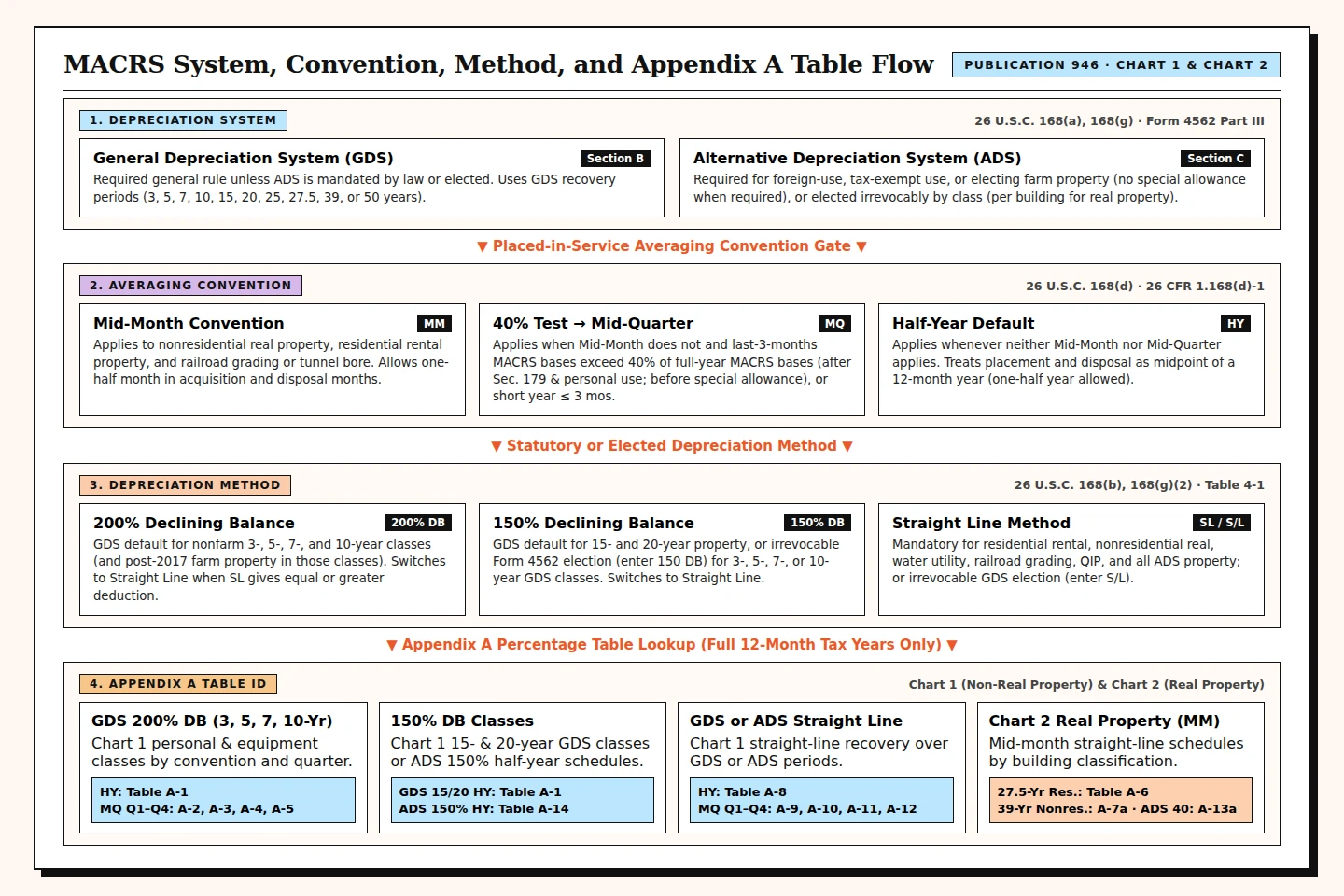
Averaging conventions establish when the recovery period begins and ends, fixing the number of months of depreciation allowed in both the placed-in-service year and the disposition year. Under 26 U.S.C. section 168(d), 26 CFR 1.168(d)-1, and chapter 4 of IRS Publication 946, evaluate the three MACRS conventions in strict order before selecting a percentage table:
- Mid-month convention: Use the mid-month convention for nonresidential real property (section 1250 property such as an office building, store, or warehouse that is neither residential rental property nor property with a class life of less than 27.5 years), residential rental property (a building or structure where 80 percent or more of gross rental income for the taxable year is from dwelling units), and any railroad grading or tunnel bore. Property placed in service or disposed of during any month is treated as placed in service or disposed of at the midpoint of that month, allowing one-half month of depreciation for that month.
- Mid-quarter convention (the 40% test): Use the mid-quarter convention when the mid-month convention does not apply and the aggregate depreciable bases of MACRS property placed in service during the last 3 months of the tax year exceed 40% of the aggregate depreciable bases of all MACRS property placed in service during the entire tax year. Under 26 CFR 1.168(d)-1, if depreciable property is placed in service during a short taxable year consisting of 3 months or less, the mid-quarter convention applies automatically. All property subject to this convention is treated as placed in service or disposed of at the midpoint of its quarter; enter MQ in column (e) of Form 4562 Part III.
- Half-year convention: Use the half-year convention whenever neither the mid-month convention nor the mid-quarter convention applies. Property is treated as placed in service or disposed of at the midpoint of the tax year, allowing a one-half year of depreciation in a 12-month placed-in-service year and in a disposition year; enter HY in column (e) of Form 4562 Part III. Thomson Reuters UltraTax CS documentation for 1040, 1120, 1065, 1041, and 990 returns notes this same Publication 946 midpoint rule and Form 4562 column (e) HY entry when mid-quarter and mid-month do not apply, while under 26 U.S.C. section 168(d)(2) and Publication 946 real property itself uses the mid-month convention.
When running the 40% mid-quarter test, exclude nonresidential real property, residential rental property, railroad grading or tunnel bore, property placed in service and disposed of in the same tax year, and property depreciated under a method other than MACRS. Watch the basis asymmetry in Publication 946: for the 40% test, depreciable basis reflects reductions for section 179 expensing and personal use, whereas it does not reflect any reduction for a special depreciation allowance.
Once system and convention are set, MACRS provides three methods under GDS and one method under ADS, treating salvage value as zero under 26 U.S.C. section 168(b)(4):
- 200% declining balance over GDS recovery period: Default GDS method for nonfarm 3-, 5-, 7-, and 10-year property (and farm property in those classes placed in service after 2017, in tax years ending after 2017), switching to straight line in the first tax year straight line on beginning adjusted basis yields an equal or larger allowance.
- 150% declining balance over GDS recovery period: Applies to 15- and 20-year GDS property (plus farm property in the 3-, 5-, 7-, or 10-year classes placed in service before 2018 and qualified smart electric meters or smart grid systems), or by irrevocable election for 3-, 5-, 7-, or 10-year GDS property by entering 150 DB in column (f) of Form 4562 Part III.
- Straight line over GDS or ADS recovery period: Required under GDS for nonresidential real property, residential rental property, railroad grading or tunnel bore, water utility property, trees or vines bearing fruits or nuts, and qualified improvement property; elected irrevocably for GDS classes by entering S/L in column (f) of Form 4562 Part III; and mandatory for all ADS property. Any GDS method election must be made by the return due date (including extensions) for the placed-in-service year and cannot be changed once made.
How is MACRS depreciation calculated with and without tables?
With the IRS Appendix A percentage tables, multiply the property’s fixed unadjusted basis by the table percentage each recovery year; without the tables, subtract prior depreciation from adjusted basis each year, apply the declining balance rate and convention, and switch to straight line when straight line yields an equal or greater deduction. Computing MACRS without the tables generally produces a slightly different deduction amount than the percentage tables.
Rules and boundaries for using IRS Appendix A percentage tables
Appendix A percentage tables already incorporate both the averaging convention and the switch from declining balance to straight line. Publication 946 sets four strict operating rules for table users:
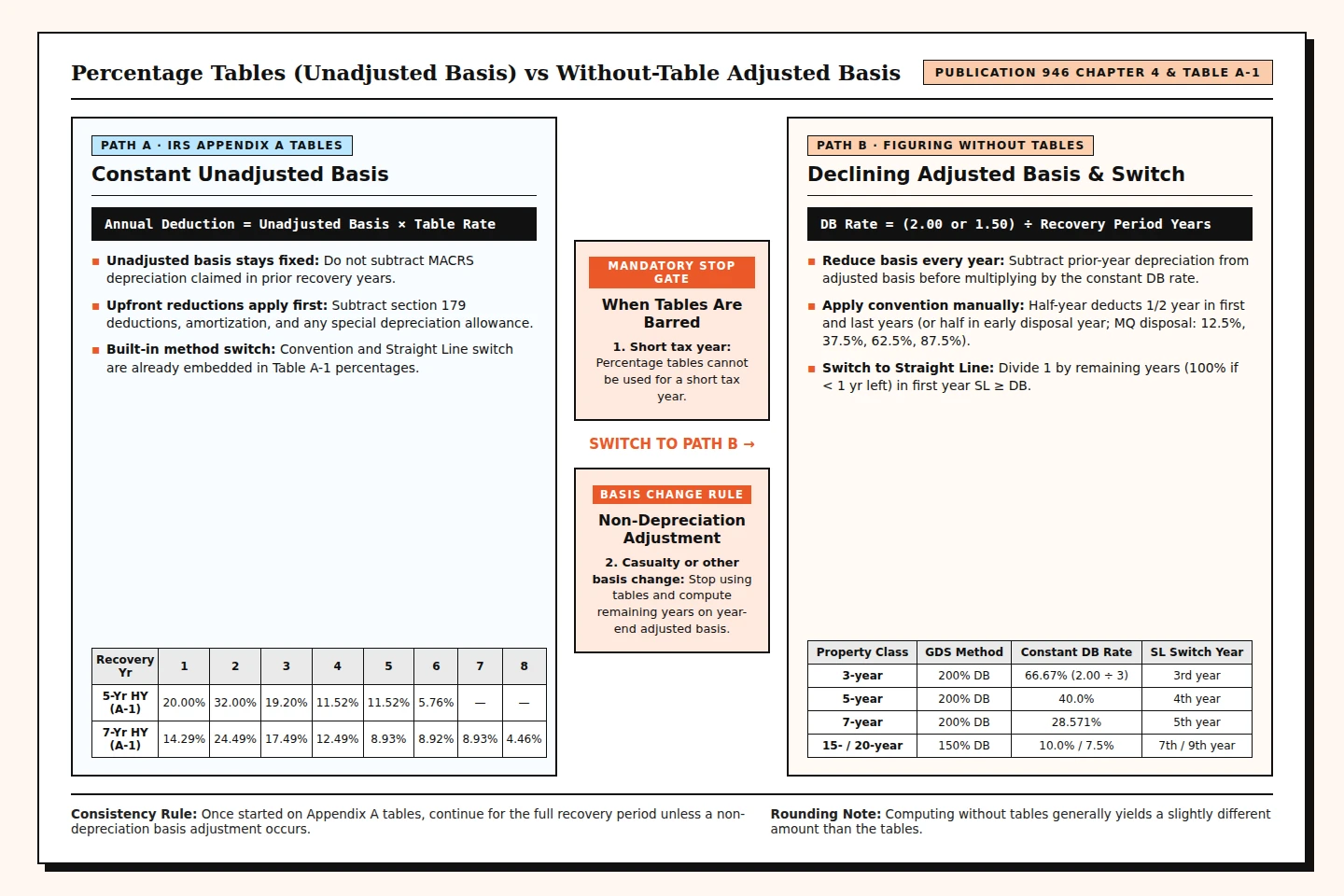
- Apply rates to unadjusted basis every year: Multiply the property’s unadjusted basis by the applicable table percentage in every year of the recovery period. Unadjusted basis is the basis that would be used to figure gain on a sale, computed without reducing original basis for MACRS depreciation claimed in earlier years, after multiplying cost or other basis by the business/investment-use percentage and subtracting allocable credits, amortization, any section 179 deduction, and any special depreciation allowance.
- Never use tables for a short tax year: Percentage tables cannot be used in a short tax year.
- Stay on the tables across the recovery period: Once you start using the percentage tables for an item of property, you must generally continue using them for the entire recovery period.
- Stop using tables after a non-depreciation basis adjustment: You must stop using the percentage tables if you adjust basis for any reason other than depreciation allowed or allowable, or an addition or improvement depreciated as a separate asset. If a deductible casualty loss reduces property basis, table use ends immediately; for the casualty year and all remaining recovery years, figure depreciation without the tables using adjusted basis at the end of the year.
Publication 946 illustrates both table usage and the casualty stop rule in its chapter 4 examples. In its office-furniture example for 7-year property placed in service on August 11, 2025 as the only asset placed in service that year—with 100% business/investment use, zero section 179 election, and no special depreciation allowance—the filled MACRS worksheet applies GDS, 200%DB/Half-Year, and Table A-1’s year 1 rate of 0.1429 (14.29%) to the full unadjusted basis, followed across subsequent recovery years by the 7-year column percentages in Table A-1. In its Sandra and Frank Elm example for new 7-year property placed in service on October 26, 2024, the taxpayers reduce original basis by an elected section 179 deduction and claim a 2024 table deduction, then incur a deductible vandalism casualty loss in July 2025; because the casualty loss reduces basis for a reason other than depreciation, they can no longer use Appendix A tables and must compute 2025 depreciation without the tables from year-end adjusted basis.
Figuring MACRS deductions without the percentage tables
When you elect or are required to compute depreciation without the tables, reduce adjusted basis before each year’s calculation by the depreciation claimed in prior years, then apply the declining balance rate and straight-line comparison:
Declining balance rate = Specified percentage as decimal (2.00 or 1.50) / Recovery period in years

Straight line rate = 1 / Years remaining in recovery period at beginning of tax year
(If years remaining is less than 1, straight line rate = 1.0, or 100%)
Publication 946 shows the exact rate division: for 3-year property under 200% declining balance, divide 2.00 by 3 to get 0.6667 (66.67%); for 15-year property under 150% declining balance, divide 1.50 by 15 to get 0.10 (10%). Under the half-year convention without tables, deduct a half-year of depreciation in the first year and in the last year, and a full year of depreciation in each intermediate recovery year. Account for the placed-in-service convention when counting remaining years at the start of each tax year, and switch to straight line in the first year straight line yields an equal or greater deduction:
Scroll horizontally to see all columns.
| Property Class | GDS Method | Declining Balance Rate (%) | Recovery Year of Switch to Straight Line |
|---|---|---|---|
| 3-year property | 200% DB | 66.667% | 3rd year |
| 5-year property | 200% DB | 40.0% | 4th year |
| 7-year property | 200% DB | 28.571% | 5th year |
| 15-year property | 150% DB | 10.0% | 7th year |
| 20-year property | 150% DB | 7.5% | 9th year |
How do you read a MACRS depreciation table?
Locate the right Appendix A table through the MACRS Percentage Table Guide—Chart 1 for property other than residential rental and nonresidential real property, and Chart 2 for residential rental and nonresidential real property—then read down the recovery-year rows of your asset’s recovery-period column. Never pull a bare rate without checking the convention and quarter or month placed in service.
Chart 1 and Chart 2 route common combinations to distinct Appendix A tables:
Scroll horizontally to see all columns.
| MACRS System and Method | Recovery Period / Class | Applicable Convention | Appendix A Table ID |
|---|---|---|---|
| GDS 200% DB | GDS 3-, 5-, 7-, and 10-year classes | Half-Year | Table A-1 |
| GDS 200% DB | GDS 3-, 5-, 7-, and 10-year classes | Mid-Quarter (1st, 2nd, 3rd, or 4th quarter) | Table A-2 (1st), Table A-3 (2nd), Table A-4 (3rd), Table A-5 (4th) |
| GDS 150% DB | GDS 15- and 20-year classes | Half-Year | Table A-1 |
| GDS Straight Line or ADS Straight Line | Any GDS or ADS non-real recovery period | Half-Year | Table A-8 (Tables A-9, A-10, A-11, and A-12 for Mid-Quarter 1st through 4th quarters) |
| ADS 150% DB | ADS recovery period | Half-Year | Table A-14 |
| GDS Straight Line (Chart 2) | Residential rental property (GDS/27.5) | Mid-Month | Table A-6 (month 1 rate in year 1 is 3.485%) |
| GDS Straight Line (Chart 2) | Nonresidential real property (GDS/39; GDS/31.5) | Mid-Month | Table A-7a for 39-year (month 1 rate in year 1 is 2.461%); Table A-7 for 31.5-year |
| ADS Straight Line (Chart 2) | Residential rental and nonresidential real property at the ADS/40 recovery period | Mid-Month | Table A-13a, not the 30-year ADS recovery period for residential rental property |
Table A-1 covers 3-, 5-, 7-, 10-, 15-, and 20-year property under the half-year convention. In recovery year 1, Table A-1 prints 33.33% for 3-year property, 20.00% for 5-year property, 14.29% for 7-year property, 10.00% for 10-year property, 5.00% for 15-year property, and 3.750% for 20-year property. Because the half-year convention grants a half-year in recovery year 1 and a half-year in the final year, a 5-year recovery period spans 6 recovery rows and a 7-year recovery period spans 8 recovery rows:
Scroll horizontally to see all columns.
| Recovery Year | 5-Year Property Half-Year Rate (Table A-1) | 7-Year Property Half-Year Rate (Table A-1) |
|---|---|---|
| Recovery Year 1 | 20.00% | 14.29% |
| Recovery Year 2 | 32.00% | 24.49% |
| Recovery Year 3 | 19.20% | 17.49% |
| Recovery Year 4 | 11.52% | 12.49% |
| Recovery Year 5 | 11.52% | 8.93% |
| Recovery Year 6 | 5.76% | 8.92% |
| Recovery Year 7 | Not applicable (recovery ends in Year 6) | 8.93% |
| Recovery Year 8 | Not applicable (recovery ends in Year 6) | 4.46% |
Checking the 40% mid-quarter test before copying Table A-1 prevents a major first-year tax-shield error in equipment models. If substantial fourth-quarter placements push 5-year or 7-year property that Chart 1 sends to Table A-1 under the 200 percent half-year method into the mid-quarter convention, that fourth-quarter property uses Table A-5, where the year 1 rate is 5.00% for 5-year property and 3.57% for 7-year property instead of the Table A-1 year 1 rates of 20.00% and 14.29%. A 150 DB election for 3-, 5-, 7-, or 10-year GDS property does not use those Table A-1 half-year columns, which Chart 1 assigns to the 200 percent method; Chart 1 assigns the 150 percent half-year rate in Table A-1 to the 15- and 20-year classes and assigns Table A-14 to ADS 150 percent half-year property.
What does a MACRS depreciation schedule track across recovery periods?
A MACRS schedule tracks each asset’s Appendix B class, GDS or ADS recovery period, averaging convention, annual deduction across every recovery year, separately depreciated additions or improvements, and the fractional deduction allowed if the asset is disposed of early. Depreciation recovers basis for tax purposes; it is not a cash payment to an equipment vendor.
Under 26 U.S.C. section 168(c) and chapter 4 of Publication 946, GDS recovery periods are 3, 5, 7, 10, 15, and 20 years for personal property and land improvements, 25 years for water utility property, 27.5 years for residential rental property, 39 years for nonresidential real property, and 50 years for railroad grading or tunnel bore. Chapter 4 lists common GDS class examples directly—over-the-road tractor units in 3-year property; automobiles, taxis, buses, helicopters, trucks, and office machinery such as typewriters, calculators, and copiers in 5-year property; office furniture and fixtures such as desks, files, and safes plus property without a class life not designated elsewhere by law in 7-year property; and specified land improvements such as shrubbery, fences, roads, sidewalks, and bridges in 15-year property. Under ADS (section 168(g) and chapter 4), computers and peripheral equipment have a 5-year period, personal property with no class life has a 12-year period, residential rental property has 30 years, nonresidential real property has 40 years, and railroad grading or tunnel bore or water utility property has 50 years.
Checking both Table B-1 and Table B-2 for industrial and plant assets
Industrial equipment does not share one universal recovery period. Publication 946 Appendix B instructs taxpayers to check both Table B-1 (specific depreciable assets used in all business activities) and Table B-2 (depreciable assets used in specific business activities). Property not included in either table generally has a 7-year GDS recovery period or a 12-year ADS recovery period. In Publication 946’s retail-store example, a desk is listed in Table B-1 under class 00.11 and not specifically listed under the retail-store activity class in Table B-2, so it takes class 00.11 (10-year class life, 7-year GDS, 10-year ADS).
Compare how Appendix B separates general assets from manufacturing activity classes:
Scroll horizontally to see all columns.
| Appendix B Asset Class | Official Title and Scope | Class Life (Years) | GDS Recovery Period (Years) | ADS Recovery Period (Years) |
|---|---|---|---|---|
| 00.11 (Table B-1) | Office Furniture, Fixtures, and Equipment (desks, files, safes, communications equipment; non-structural) | 10 | 7 | 10 |
| 00.12 (Table B-1) | Information Systems (computers and peripheral equipment administering normal business; excludes computers used primarily for process or production control) | 6 | 5 | 5 |
| 00.13 (Table B-1) | Data Handling Equipment, except Computers (typewriters, calculators, adding and accounting machines, copiers, duplicating equipment) | 6 | 5 | 6 |
| 00.3 (Table B-1) | Land Improvements (depreciable sidewalks, roads, fences, canals, waterways, drainage) | 20 | 15 | 20 |
| 20.1 (Table B-2) | Manufacture of Grain and Grain Mill Products (flours, cereals, livestock feeds, grain mill products) | 17 | 10 | 17 |
| 20.4 (Table B-2) | Manufacture of Other Food and Kindred Products (foods and beverages not in classes 20.1, 20.2, and 20.3) | 12 | 7 | 12 |
| 30.1 (Table B-2) | Manufacture of Rubber Products (natural, synthetic, or reclaimed rubber products) | 14 | 7 | 14 |
| 34.0 (Table B-2) | Manufacture of Fabricated Metal Products (metal cans, tinware, fabricated structural metal, stampings) | 12 | 7 | 12 |
| 35.0 (Table B-2) | Manufacture of Electrical and Non-Electrical Machinery and Other Mechanical Products (assets used to manufacture or rebuild finished machinery and replacement parts) | 10 | 7 | 10 |
| 36.0 (Table B-2) | Manufacture of Electronic Components, Products, and Systems | 6 | 5 | 6 |
Two classification boundaries in Appendix B matter directly for production plants. First, asset class 35.0 covers assets used to manufacture or rebuild finished machinery and replacement parts; a food or grain facility looks up its production activity in Table B-2 instead (such as class 20.4 at 7-year GDS and 12-year ADS, or class 20.1 at 10-year GDS and 17-year ADS). Second, asset class 00.12 explicitly excludes equipment that is an integral part of other capital equipment included in economic activity classes—specifically computers used primarily for process or production control.
Additions, improvements, and early dispositions
When you make a capital addition or improvement to depreciable property, treat that addition or improvement as separate depreciable property with the property class and recovery period that would apply to the original asset if placed in service on the addition’s placed-in-service date. If you dispose of MACRS property before its recovery period ends, apply the convention’s disposition rule: under the half-year convention, the deduction in the disposition year is half of the full-year depreciation; under the mid-quarter convention, the disposition-year percentages of a full year’s depreciation are 12.5% in the first quarter, 37.5% in the second quarter, 62.5% in the third quarter, and 87.5% in the fourth quarter.
Where are official IRS depreciation tables published?
The official MACRS percentage tables and class-life tables are published by the Internal Revenue Service in Appendix A and Appendix B of Publication 946, supported by the Form 4562 instructions, 26 U.S.C. section 168, and 26 CFR 1.168(d)-1.
- IRS About Publication 946 and HTML text: The IRS About Publication 946 page identifies the current revision of Publication 946 (reporting recent developments as none at this time) and explains how taxpayers recover the cost of business or income-producing property, while the Publication 946 HTML edition presents chapter 4’s MACRS rules and directs readers to Appendix A for the percentage tables.
- 2025 Publication 946 PDF: The 113-page 2025 IRS Publication 946 PDF (PDF creation date March 13, 2026) prints Chart 1, Chart 2, percentage tables including Tables A-1 through A-14, and Appendix B class-life tables (Table B-1 and Table B-2).
- Form 4562 instructions, statute, and regulations: The 2025 Instructions for Form 4562 cover Part III reporting and point to chapter 4 of Publication 946 for the complete MACRS discussion. Statutory authority is codified in 26 U.S.C. section 168 on GovInfo (2024 Edition) and 26 U.S.C. section 168 on Cornell LII, and regulatory rules for the half-year and mid-quarter 40-percent test are published in 26 CFR 1.168(d)-1 on eCFR.
MACRS asset setup and table verification checklist
Record these asset-level facts before pulling a percentage from Appendix A or entering tax-shield rows into a capital-budgeting schedule:
- Depreciation system and legal basis: Record GDS (Form 4562 Part III, Section B) or ADS (Section C), whether ADS is required under 26 U.S.C. section 168(g) or irrevocably elected, and confirm that no special depreciation allowance is claimed if ADS is required by law.
- Appendix B class lookup: Check both Table B-1 and Table B-2, confirm that production-control computers are excluded from class 00.12 and that class 35.0 is restricted to machinery-manufacturing activities, or document the 7-year GDS and 12-year ADS fallback for personal property in neither table.
- Applicable GDS and ADS recovery periods: Record both the GDS recovery period and the ADS recovery period for the asset class, and log any capital addition or improvement as its own separate depreciable asset.
- Placed-in-service date and averaging convention: Record the date the asset was ready and available for its specific use (or converted from personal use), apply mid-month for real property and railroad grading, test whether MACRS bases placed in service during the last 3 months exceed 40% of full-year MACRS bases (after section 179 and personal use, without subtracting special depreciation allowances, or in a tax year of 3 months or less) for mid-quarter (MQ), or assign the half-year default (HY).
- Depreciation method and Appendix A table ID: Record 200% DB, 150% DB, or straight line, note any irrevocable Form 4562 column (f) election (150 DB or S/L), match Chart 1 or Chart 2 to the exact Appendix A table ID, and confirm the tax year is not a short tax year.
- Unadjusted basis before table rates: Multiply cost or other basis by the business/investment-use percentage and subtract section 179 deductions, amortization, and any special depreciation allowance, keeping prior-year MACRS deductions out of unadjusted basis.
- Non-depreciation basis change and disposition check: Record yes or no on whether a deductible casualty loss or other non-depreciation basis adjustment occurred after placement—if yes, stop using Appendix A tables and switch to year-end adjusted basis—and apply half of the full-year depreciation under half-year or the 12.5%, 37.5%, 62.5%, or 87.5% mid-quarter fraction in any early disposition year.
Once each asset’s recovery period, convention, and unadjusted basis are verified, pair this checklist with CapEx vs OpEx for Production Equipment to confirm invoice-line capitalization, ROI Calculation in Excel for Equipment CapEx to model discounted after-tax cash flows, or the full Analysis and Automation Investment guides.
Sources
- Internal Revenue Service, Publication 946, How To Depreciate Property (HTML)
- Internal Revenue Service, 2025 Publication 946, How To Depreciate Property (PDF)
- Internal Revenue Service, About Publication 946, How To Depreciate Property
- Internal Revenue Service, 2025 Instructions for Form 4562, Depreciation and Amortization
- U.S. Government Publishing Office (GovInfo), 26 U.S.C. section 168 — Accelerated cost recovery system (2024 Edition)
- Cornell Law School Legal Information Institute, 26 U.S.C. section 168 — Accelerated cost recovery system
- Electronic Code of Federal Regulations (eCFR), 26 CFR 1.168(d)-1 — Applicable conventions: half-year and mid-quarter conventions
- Thomson Reuters, UltraTax CS Help: MACRS half-year convention (attribution only)