 WonksAnonymous
Equivalent Annual Cost: Formula & Asset Lifespans
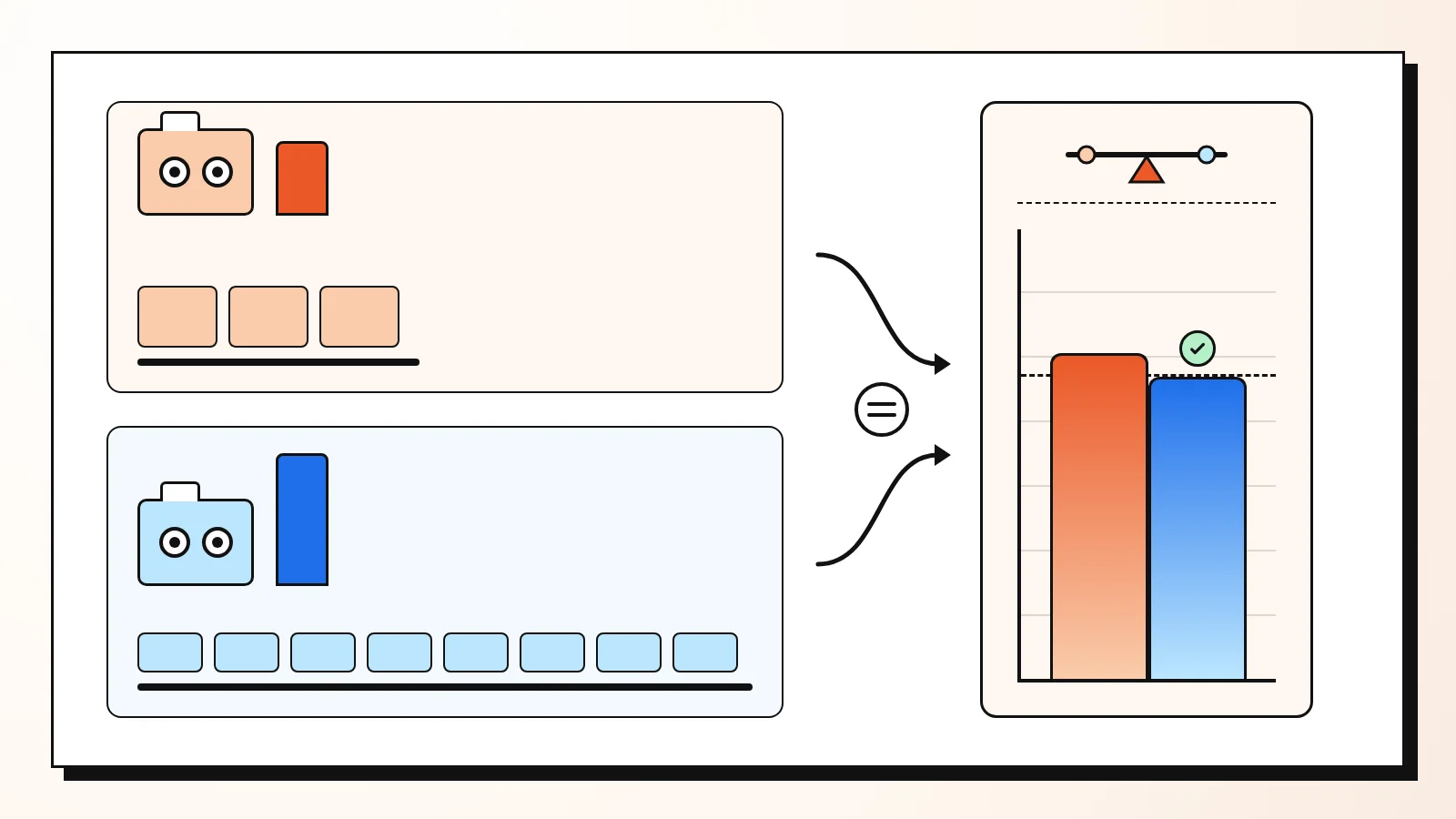
Equivalent annual cost turns an asset's present cost and its own life into one yearly amount, so unequal equipment lives can be compared.
Equivalent annual cost (EAC) is the cost per year of owning and operating an asset over its entire lifespan. In Wikipedia’s 5% machine illustration, dividing each investment cost by its annuity factor and adding annual maintenance puts the 3-year machine at 31360 and the 8-year machine at 30708, so Machine B has the lower EAC.
What does equivalent annual cost mean?
The English Wikipedia article on equivalent annual cost defines equivalent annual cost as the cost per year of owning and operating an asset over its entire lifespan, used in capital budgeting when comparing investment projects of unequal lifespans. Wikipedia sets one hard boundary on that comparison: the projects being compared must have equal risk, and otherwise EAC must not be used.
Other industry references state the same annual cost concept in closely aligned terms. GoCardless defines equivalent annual cost as the cost-per-year of owning, operating, and maintaining an asset over the course of its entire lifespan, and notes that the main disadvantage of equivalent annual cost analysis is that you need to estimate the discount rate. The IFMA Knowledge Library glossary defines equivalent annual cost as the cost per year of owning and operating an asset over its entire lifespan and states that this measure facilitates comparisons of the cost effectiveness of various assets.
Wikipedia lists three capital-budgeting applications for EAC:
- Assessing alternative projects of unequal lives, where only the costs are relevant, to address any built-in bias favouring the longer-term investment.
- Determining the optimum economic life of an asset by charting the change in EAC that may occur as operating costs and salvage values fluctuate over time.
- Sizing how much should be invested in an asset to achieve a similar EAC, such as purchasing a storage tank with a 20-year life as opposed to one with a 5-year life.
Within our Analysis archive and the Automation Investment guide, align supplier scope first in Comparing Packaging Machinery Quotes, or review Automation Payback, ROI and TCO when choosing among capital metrics.
What is the equivalent annual cost formula?
Wikipedia signed NPV and annuity-factor notation
Wikipedia calculates EAC by dividing the negative NPV of a project by the present value of annuity factor: EAC = -NPV / A(t, r), where A(t, r) = (1 - 1 / (1 + r)^t) / r, r is the annual interest rate, and t is the number of years. Wikipedia also states that EAC can be obtained by multiplying the NPV of the project by the loan repayment factor.
Keep track of the sign convention before entering numbers. Dividing negative NPV by A(t, r) converts a discounted net cost outflow into a positive annual figure, whereas Wikipedia’s worked machine example divides a positive investment cost directly by the annuity factor and adds level annual maintenance. GoCardless writes Equivalent Annual Cost = NPV / A(t, r) without Wikipedia’s minus sign and omits a closing parenthesis on its annuity-factor line, so verify every parenthesis when typing the denominator.
NIST uniform capital recovery factor and worked checks
In NIST Handbook 135 (2020 edition)—the 295-page Life Cycle Costing Manual for the Federal Energy Management Program authored by Joshua Kneifel—NIST expresses the same annualization with the Uniform Capital Recovery (UCR) factor. Its glossary defines the UCR factor as a discount factor by which a present amount may be multiplied to find its equivalent annual value for a given discount rate and period, and notes that the UCR factor is the inverse of the uniform present value (UPV) factor for the same number of years and same discount rate.
In Equation (9-1) of NIST Handbook 135, the uniform capital recovery factor is UCR = [d × (1 + d)^N] / [(1 + d)^N - 1], where d is the discount rate and N is the life expectancy of the system (or the study period if shorter).
Scroll horizontally to see all columns.
| Source and Notation | Formula Relationship | Worked Numerical Check (Unnamed Currency Unit) |
|---|---|---|
| Wikipedia annuity factor, A(t, r) | EAC = -NPV / A(t, r), with A(t, r) = (1 - 1 / (1 + r)^t) / r | At r = 5%, 50000 / A(3, 5) + 13000 = 31360; 150000 / A(8, 5) + 7500 = 30708 |
| NIST Handbook 135 (2020) UCR factor | Annualized investment = Initial investment (less PV of residual) × [d × (1 + d)^N] / [(1 + d)^N - 1] | N = 20 years, d = 3.0% gives UCR = 0.0672; 50000 × 0.0672 = 3360 |
| NIST Handbook 135 (2020) Section 17.4 | Annual value A = P × [d × (1 + d)^n] / [(1 + d)^n - 1] | P = 1000, d = 5%, n = 10 gives annual value A = 130 |
How do you calculate equivalent annual cost?
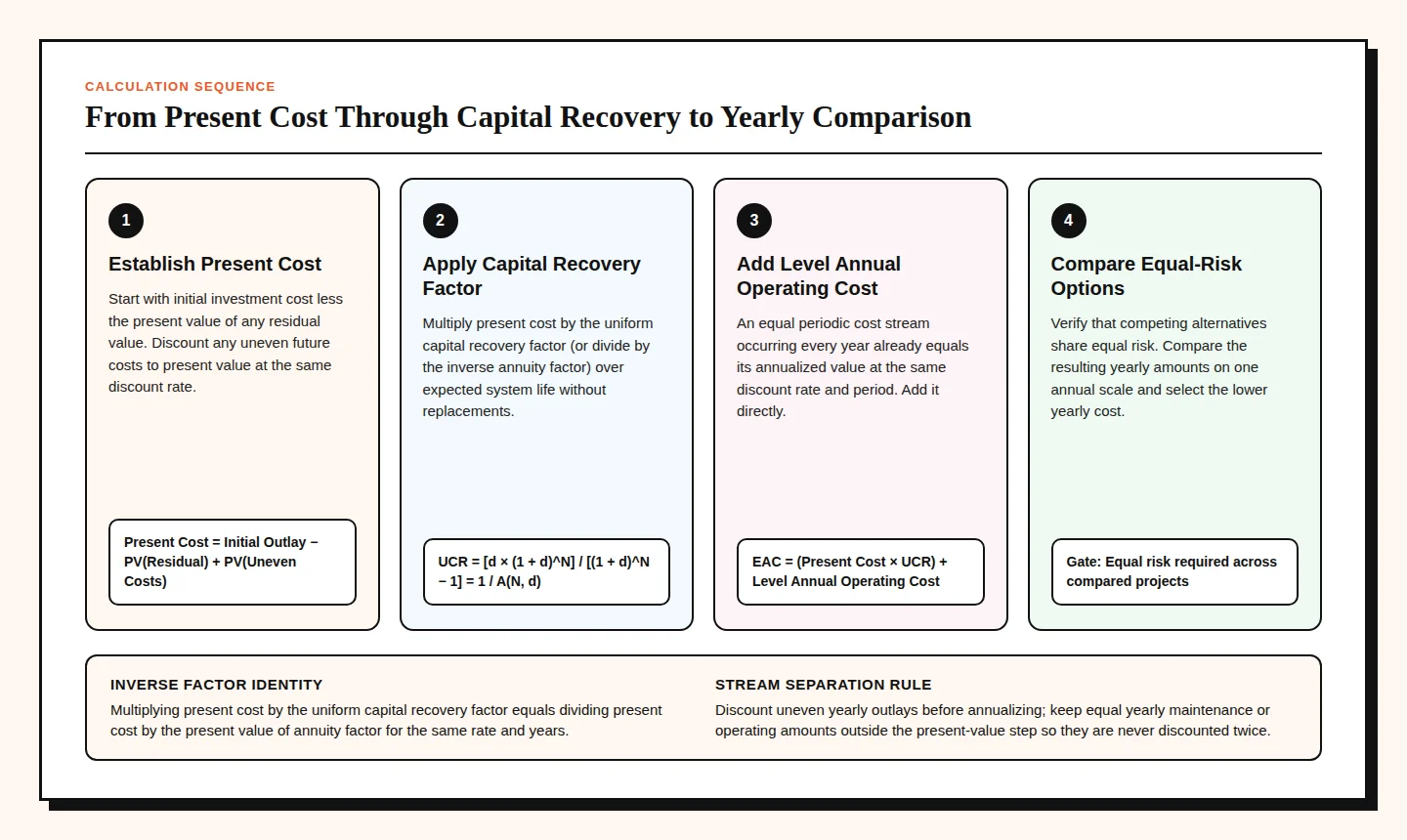
Compute equivalent annual cost by separating one-time or uneven cash flows from level yearly operating expenses so no stream is discounted twice:
- Find net present capital cost: Take the project’s initial investment cost less the present value of any residual value. NIST states that the UCR factor should be based on the expected life of the new system, without replacements.
- Discount any uneven periodic costs first: Section 17.4 of NIST Handbook 135 uses the annual-value formula to determine an equal payment per time period (usually years) equivalent to a one-time cost or a stream of costs over the same period. Any single cost or stream of uneven costs over a given period is annualized by first finding its present value at the same discount rate and then applying the UCR formula.
- Multiply present cost by UCR (or divide by the annuity factor): Convert the combined present cost into an equal yearly capital charge over the asset’s life.
- Add level annual operating and maintenance costs directly: For a stream of equal costs occurring in each time period over a given study period, NIST states that the annualized cost is identical to that periodic cost when the same discount rate and study period are used.
For multi-year uneven cash-flow discounting and IRR schedules, use ROI Calculation in Excel for Equipment CapEx.
How do you set up equivalent annual cost in Excel?
Microsoft Support states that the PMT function calculates the payment for a loan based on constant payments and a constant interest rate, using the syntax PMT(rate, nper, pv, [fv], [type]). In that syntax, rate is the interest rate, nper is the total number of payments, and pv is the present value—the total amount that a series of future payments is worth now.
The optional type argument is 0 or 1 and indicates when payments are due: type 0 or omitted means payments are due at the end of the period, whereas type 1 means payments are due at the beginning of the period. Keep rate and nper in matching annual units when calculating an annual equivalent cost—Microsoft’s annual payment unit check pairs an annual percentage rate with an annual payment count rather than monthly periods—and add any equal yearly maintenance or operating cost outside PMT because a level annual stream is already in annual terms.
How does an equivalent annual cost example compare two assets?
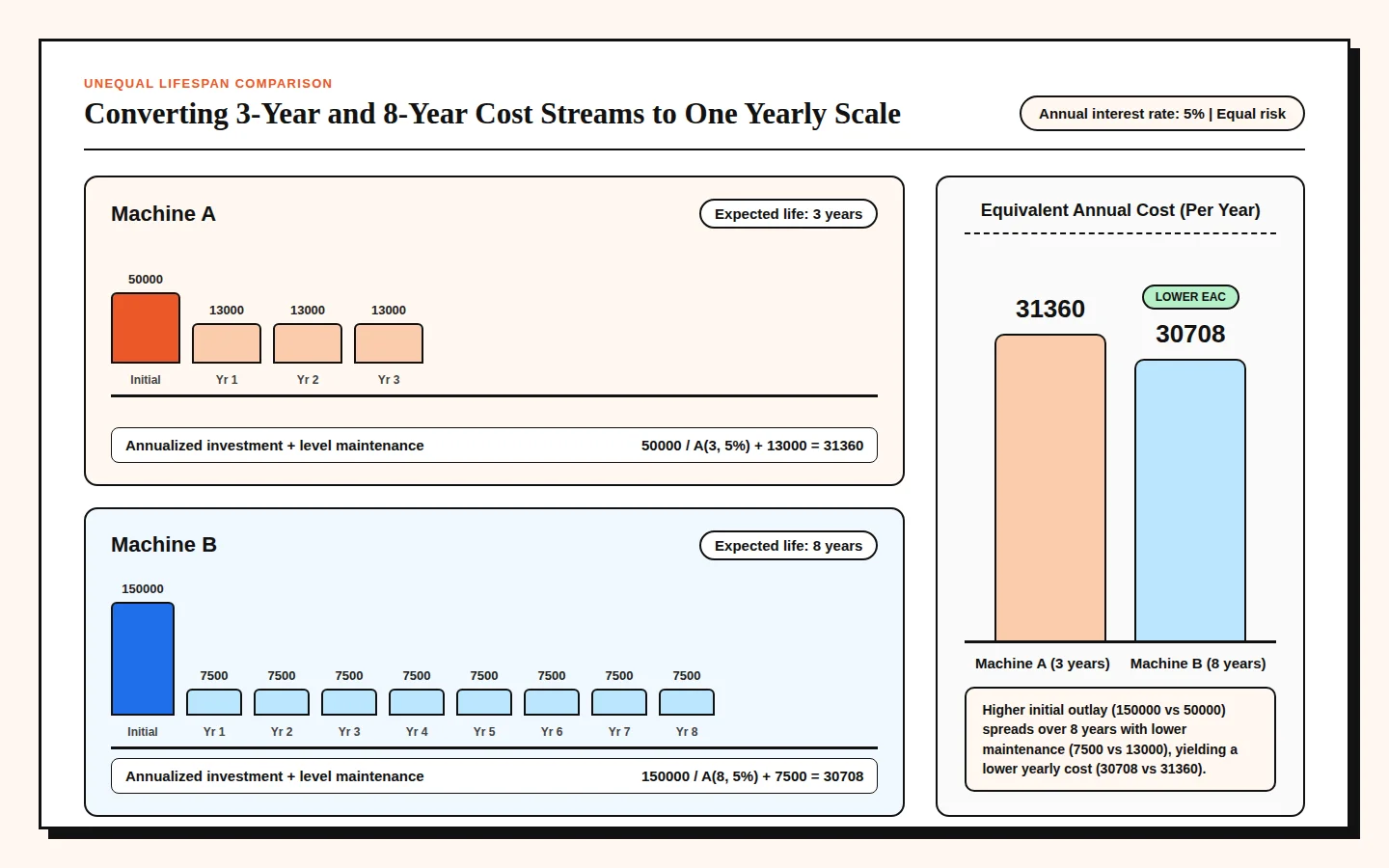
Wikipedia’s capital-budgeting illustration compares two machines at an annual interest rate of 5% (expressed here in one unnamed currency unit):
Scroll horizontally to see all columns.
| Parameter | Machine A | Machine B |
|---|---|---|
| Investment cost | 50000 | 150000 |
| Expected lifetime | 3 years | 8 years |
| Annual interest rate | 5% | 5% |
| Annual maintenance cost | 13000 | 7500 |
| Equivalent annual cost setup | 50000 / A(3, 5) + 13000 | 150000 / A(8, 5) + 7500 |
| Equivalent annual cost | 31360 | 30708 |
| Decision under equal risk | Higher annual cost | Invest in Machine B (lower EAC) |
Wikipedia’s conclusion is to invest in Machine B since it has a lower EAC (30708 versus 31360), even though Machine B’s initial investment of 150000 is higher than Machine A’s 50000.
NIST Handbook 135 (2020 edition) applies the same UCR arithmetic to replacement timing: if the annualized investment cost of a new system is less than its expected yearly savings, and those yearly savings are expected to remain constant or increase over time, it is cost-effective to replace the existing system now. In NIST’s 20-year, 3.0% check on an investment cost of 50000, annualized investment cost is 3360, annual savings of at least 3360 justify replacement, and annual savings of 4000 (40% of 10000 at today’s energy prices) make replacement cost-effective; optimal replacement timing does not depend on the remaining life of the existing system because its cost is a sunk cost when salvage value is zero.
Per-life EAC vs shared-study-period life-cycle cost
Own-life EAC versus NIST shared study periods
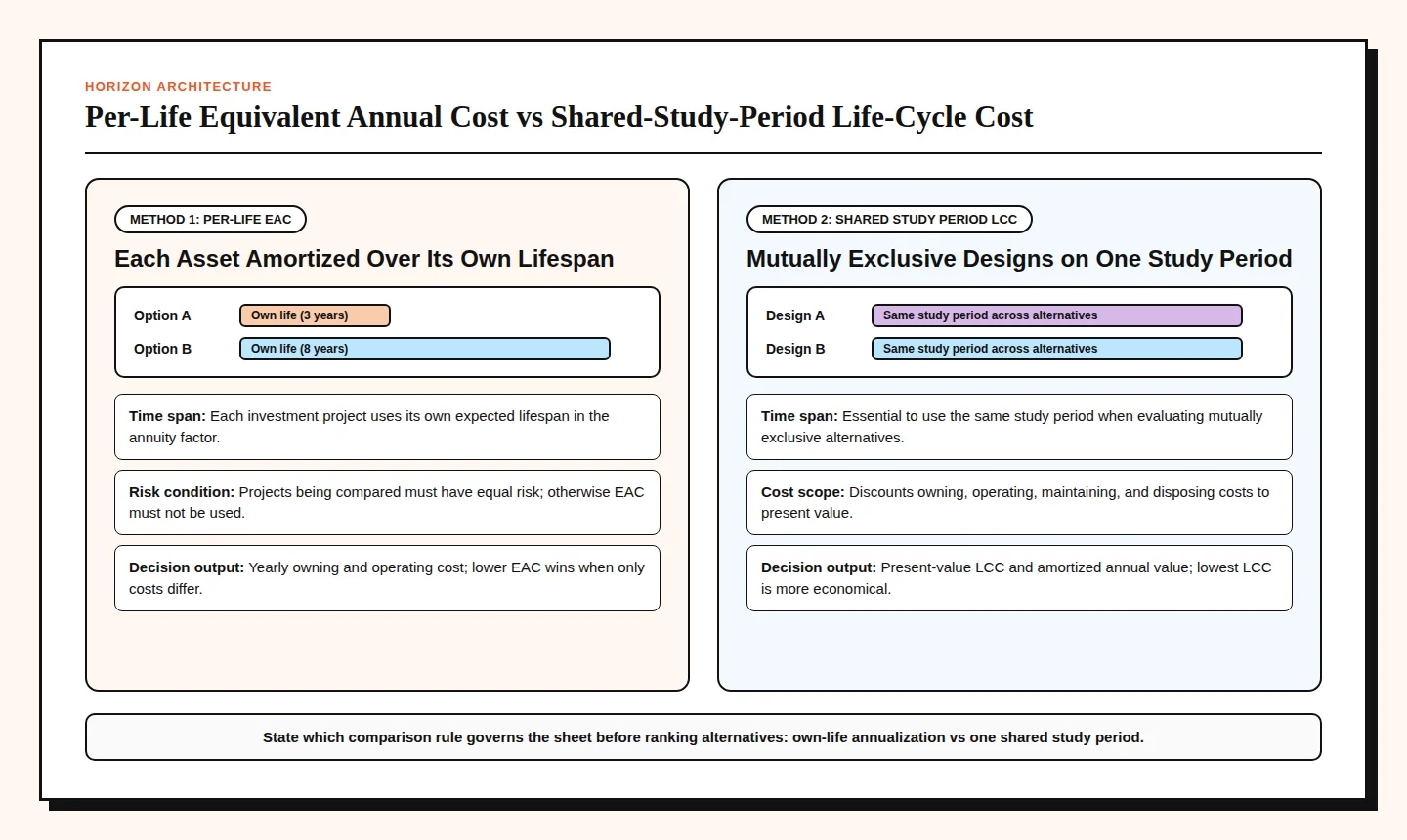
Wikipedia’s EAC ranks equal-risk projects by amortizing each asset over its own lifespan, whereas life-cycle cost analysis (LCCA) in NIST Handbook 135 evaluates competing designs over one common study period. NIST defines life-cycle cost (LCC) as the total cost of owning, operating, maintaining, and disposing of a system over a given study period, adjusted for the time value of money through discounting, and defines annual value as the cost resulting from amortizing all project costs evenly over that study period.
Design alternatives that perform the same function are mutually exclusive because only one alternative can be selected. NIST states that there is no single correct study period, yet it is essential to use the same study period when evaluating mutually exclusive project alternatives; the same study period is not required when ranking independent projects for funding allocation by savings-to-investment ratio (SIR) or adjusted internal rate of return (AIRR). As documented on the Department of Energy FEMP Building Life Cycle Cost Programs page and the NIST Building Life Cycle Cost Programs page, NIST’s BLCC software computes LCC in both present value and annual value terms—alongside net savings, SIR, AIRR, and years to payback—and is typically used for alternative designs that have higher initial costs and lower operating costs over the project life than the lowest-initial-cost design, where the lowest LCC is more economical in the long run. The FEMP page notes a 2025 revision to Handbook 135; the handbook formulas and worked examples on this page reference the 2020 edition.
Federal rules, OMB Circular A-94, and tax-life boundaries
Keep federal program limits separate from private capital budgeting. In the 2020 edition of NIST Handbook 135, FEMP LCC rules under 10 CFR 436 14(d) set a maximum service period of 40 years from the beginning of beneficial use (a maximum study period of 40 years plus the planning and construction period) and a real discount rate floor of 3% and ceiling of 10%. Those statutory FEMP limits govern federal energy evaluations rather than private plant hurdle rates, and Wikipedia’s 5% rate is an example assumption.
Although the 2020 handbook noted that the older OMB circular had no maximum study period length or real discount rate restrictions, the revised OMB Circular No. A-94 replaces and rescinds OMB Circular No. A-94 dated October 29, 1992. That revised circular provides general guidance for federal benefit-cost and cost-effectiveness analyses and specific guidance on federal discount rates, defines a cost-effective project as having the lowest life-cycle costs in present value terms for a given amount of benefits (when alternatives share the same annual monetary benefits or the same annual effects), compares the net discounted present-value life-cycle cost of leasing with the full costs of buying or constructing an identical asset, and defines economic life for lease-purchase analysis as productive lifetime from acquisition to retirement—noting that economic life is frequently not the same as useful life for tax purposes. For U.S. tax recovery periods and IRS percentage tables, use MACRS Depreciation.
Two-asset equivalent annual cost check
Record your own inputs for two candidate assets in one consistent currency unit before comparing yearly figures:
Scroll horizontally to see all columns.
| Check Item | Asset A Entry | Asset B Entry |
|---|---|---|
| Expected life in years (t or N) | Enter Asset A service life in years | Enter Asset B service life in years |
| Annual discount rate (r or d) | Enter estimated annual discount rate | Enter same annual discount rate |
| Present cost (initial outlay less PV of residual, plus PV of uneven costs) | Enter Asset A net present cost | Enter Asset B net present cost |
| Annuity factor A(t, r) or capital recovery factor UCR | Enter factor for Asset A life and rate | Enter factor for Asset B life and rate |
| Annualized capital cost | Divide Asset A present cost by A(t, r) or multiply by UCR | Divide Asset B present cost by A(t, r) or multiply by UCR |
| Level annual operating and maintenance cost | Enter Asset A equal yearly operating cost | Enter Asset B equal yearly operating cost |
| Equivalent annual cost | Sum Asset A annualized capital cost and level yearly operating cost | Sum Asset B annualized capital cost and level yearly operating cost |
| Lifespan difference check | Note whether Asset A life differs from Asset B | Note whether Asset B life differs from Asset A |
| Equal-risk verification | Confirm Asset A shares equal risk (do not use EAC if risk differs) | Confirm Asset B shares equal risk (do not use EAC if risk differs) |
Frequently asked questions
What does equivalent annual cost mean?
Equivalent annual cost is the yearly cost of owning and operating an asset across its full lifespan. In capital budgeting, it puts unequal-lifespan projects onto one annual cost basis provided the alternatives carry equal risk, and IFMA notes that it facilitates comparing asset cost effectiveness.
How do you calculate equivalent annual cost?
Discount any uneven cash flows and residual value to present cost, convert that present cost into an annual capital charge using the annuity factor or NIST’s uniform capital recovery factor over the new system’s expected life without replacements, and add any equal yearly operating or maintenance cost directly.
What is the equivalent annual cost formula?
Wikipedia writes EAC = -NPV / A(t, r), where A(t, r) = (1 - 1 / (1 + r)^t) / r for annual interest rate r and years t, or NPV multiplied by the loan repayment factor. Equivalently, NIST Handbook 135 multiplies present cost by UCR = [d × (1 + d)^N] / [(1 + d)^N - 1], the inverse of the uniform present value factor.
How do you set equivalent annual cost up in a spreadsheet?
Per Microsoft Support, PMT(rate, nper, pv, [fv], [type]) computes a constant loan payment from a constant interest rate, payment count, and present value, with type 0 (or omitted) for end-of-period payments and type 1 for beginning-of-period payments. Supply an annual rate and annual period count, then add any level yearly operating cost outside PMT.
Which asset wins when the lives differ?
Among equal-risk alternatives where only costs differ, the asset with the lower equivalent annual cost wins. In Wikipedia’s 5% machine comparison, 8-year Machine B (investment 150000, maintenance 7500, EAC 30708) beats 3-year Machine A (investment 50000, maintenance 13000, EAC 31360) despite Machine B’s higher upfront outlay.
Sources
- English Wikipedia, Equivalent annual cost
- National Institute of Standards and Technology, NIST Handbook 135 (2020 Edition), Life Cycle Costing Manual for the Federal Energy Management Program (PDF)
- Office of Management and Budget, Circular No. A-94, Guidelines and Discount Rates for Benefit-Cost Analysis of Federal Programs (PDF)
- U.S. Department of Energy Federal Energy Management Program, Building Life Cycle Cost Programs
- National Institute of Standards and Technology, Building Life Cycle Cost Programs
- GoCardless, Equivalent annual cost guide
- IFMA Knowledge Library, Equivalent annual cost (EAC) glossary entry
- Microsoft Support, PMT function reference