 WonksAnonymous
Rollstock Versus Premade Pouches: Comparing the Total Packaging Cost
How to put rollstock and premade pouches on one cost basis: material, waste, labor, equipment and order structure, with two worked scenarios and a break-even formula.
You can pack a product on a form-fill-seal machine fed with film, or on a machine that fills pouches you bought ready-made. Film costs less than finished pouches, so rollstock looks like the obvious saving. But material price is only one line of the bill, and which route costs less per good pack depends on your volume, your number of designs and your product.
Neither format wins everywhere. Rollstock tends to win at steady, high volume with few designs. Premade pouches tend to win when volumes are lower, designs are many and runs are short, because waste, changeovers and minimum orders then outweigh the price gap per unit. The sections below put both routes on one cost basis so you can find the crossover for your own inputs.
Two routes, one difference
In the rollstock route, you buy printed or plain film on a roll. A form-fill-seal machine, for example a vertical form-fill-seal (VFFS) machine, forms the film into a pouch around a forming tube, fills it and seals it, all in one machine. The converting step, turning flat film into a pouch, happens in your plant.
In the premade route, a converter makes finished pouches and ships them to you in cartons or stacks. A premade pouch machine opens each pouch, fills it and seals it. Converting happens at the supplier, and the pouch price includes that work.
Premade pouches often allow zippers, spouts and shaped or stand-up formats that can be harder or costlier to form inline. Rollstock lets you pay for film instead of finished pouches. Both are tendencies, not rules, and they depend on the pack, the film and the machine.
The cost model
Use the same period and the same units, and count good packs only, as in Cost per Good Pack: A More Useful Measure Than Nameplate Speed. Calculate each route separately, then compare.
packaging material per pack
  rollstock: film cost per pack = film price per kg x film mass per pack
             (or film price per 1,000 m2 x film area per pack)
  premade:   pouch price per 1,000 / 1,000

material waste
  = packaging material per pack x waste rate
    (setup waste + running waste, as a share of net material)

cash operating cost per year
  = (material + material waste) x good packs per year
    + labor + energy + maintenance

labor    = operating hours x operators x loaded hourly rate
hours    = good packs per year / effective good packs per hour
allocated equipment per year = installed cost / life in years
                               (separate line, straight-line, comparison only)

cost per 1,000 good packs
  = (cash operating cost + allocated equipment) / good packs x 1,000
Show cash operating cost and the figure including allocated equipment as two separate lines. The allocation is a comparison assumption, not depreciation. For what belongs in the installed cost, see The True Installed Cost of Packaging Automation.
Worked example: steady volume
Worked example. Replace each input with a quote or a measured figure from the plant before using the result.
One product and one pack size, 1.5 million good packs per year, few designs and long runs. Labor is $30 per hour loaded, with one operator on each machine. Energy is charged per running hour, and maintenance is an annual amount.
Scroll horizontally to see all columns.
| Input | Rollstock (VFFS) | Premade pouch |
|---|---|---|
| Material per 1,000 packs | $30 | $42 |
| Waste rate | 4% | 1.5% |
| Effective speed, good packs per minute | 50 | 40 |
| Operators | 1 | 1 |
| Energy per running hour | $6 | $5 |
| Maintenance per year | $4,500 | $3,500 |
| Installed equipment cost | $150,000 | $90,000 |
| Life for allocation | 10 years | 10 years |
The derived figures: rollstock runs 1,500,000 / (50 x 60) = 500 hours, and premade runs 1,500,000 / (40 x 60) = 625 hours.
Scroll horizontally to see all columns.
| Line (per year) | Rollstock | Premade |
|---|---|---|
| Material (1,500 x $30 / 1,500 x $42) | $45,000 | $63,000 |
| Material waste (4% / 1.5%) | $1,800 | $945 |
| Labor (500 h / 625 h x $30) | $15,000 | $18,750 |
| Energy (500 h x $6 / 625 h x $5) | $3,000 | $3,125 |
| Maintenance | $4,500 | $3,500 |
| Cash operating cost | $69,300 | $89,320 |
| Allocated equipment ($150,000 / 10, $90,000 / 10) | $15,000 | $9,000 |
| Cash plus allocated equipment | $84,300 | $98,320 |
| Cash cost per 1,000 good packs | $46.20 | $59.55 |
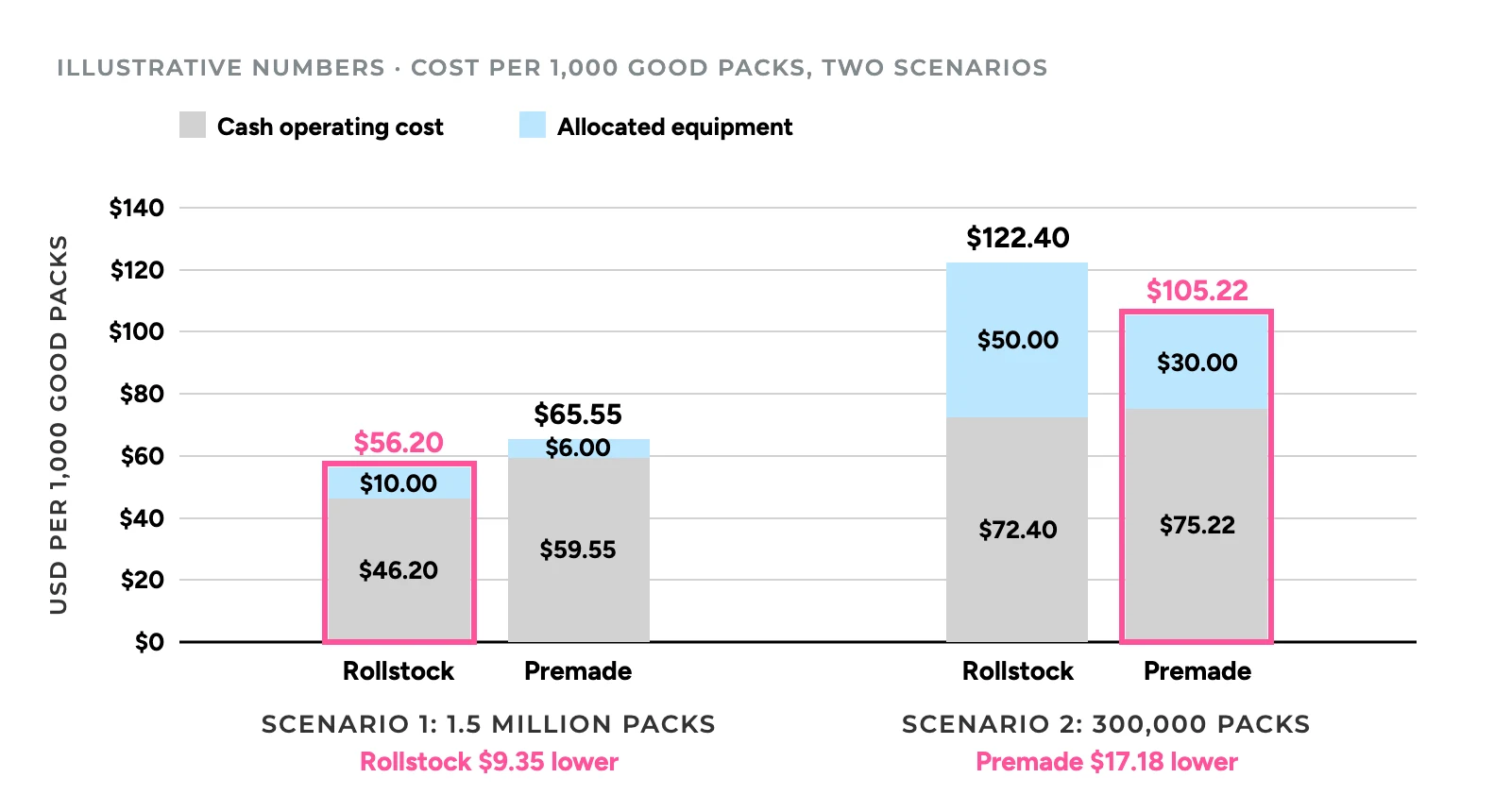
| Total per 1,000 good packs | $56.20 | $65.55 |
Under these inputs rollstock costs $9.35 less per 1,000 packs, even after paying for the more expensive machine. The $12 pouch price premium per 1,000 does most of the work, helped by the speed assumption. If your premade quote is closer to the film cost, or the premade machine runs as fast, the result moves.
Worked example: lower volume, many designs
Worked example. Replace each input with a quote or a measured figure from the plant before using the result.
Now 300,000 good packs per year, spread over many designs in short runs. Three things change. Each film changeover, with its web threading and print-register adjustment, wastes more material and time. Printed film comes with minimum order quantities, which pushes you toward buying more film than the short runs use (see the order structure section below). Pouches for short runs cost somewhat more per unit but change over faster. Equipment, labor rate, energy rates and maintenance stay the same.
Scroll horizontally to see all columns.
| Input | Rollstock (VFFS) | Premade pouch |
|---|---|---|
| Material per 1,000 packs | $34 | $44 |
| Waste rate | 10% | 3% |
| Effective speed, good packs per minute | 30 | 32 |
Hours: rollstock 300,000 / (30 x 60) = 166.67, premade 300,000 / (32 x 60) = 156.25.
Scroll horizontally to see all columns.
| Line (per year) | Rollstock | Premade |
|---|---|---|
| Material (300 x $34 / 300 x $44) | $10,200 | $13,200 |
| Material waste (10% / 3%) | $1,020 | $396 |
| Labor (166.67 h / 156.25 h x $30) | $5,000 | $4,687.50 |
| Energy (166.67 h x $6 / 156.25 h x $5) | $1,000 | $781.25 |
| Maintenance | $4,500 | $3,500 |
| Cash operating cost | $21,720 | $22,564.75 |
| Allocated equipment | $15,000 | $9,000 |
| Cash plus allocated equipment | $36,720 | $31,564.75 |
| Cash cost per 1,000 good packs | $72.40 | $75.22 |
| Total per 1,000 good packs | $122.40 | $105.22 |
The ranking flips. Premade costs $17.18 less per 1,000 packs (122.40 - 105.22 = 17.18, using the unrounded $105.2158). Rollstock is still slightly cheaper on cash cost per 1,000 ($72.40 against $75.22), but its heavier equipment allocation is spread over only 300,000 packs. It’s the same fixed-cost effect described in How Equipment Utilization Changes Automation Payback.
If you run many short-run SKUs, price an outside packer as a third route; see contract packing versus owning a packaging line.
Where the break-even sits
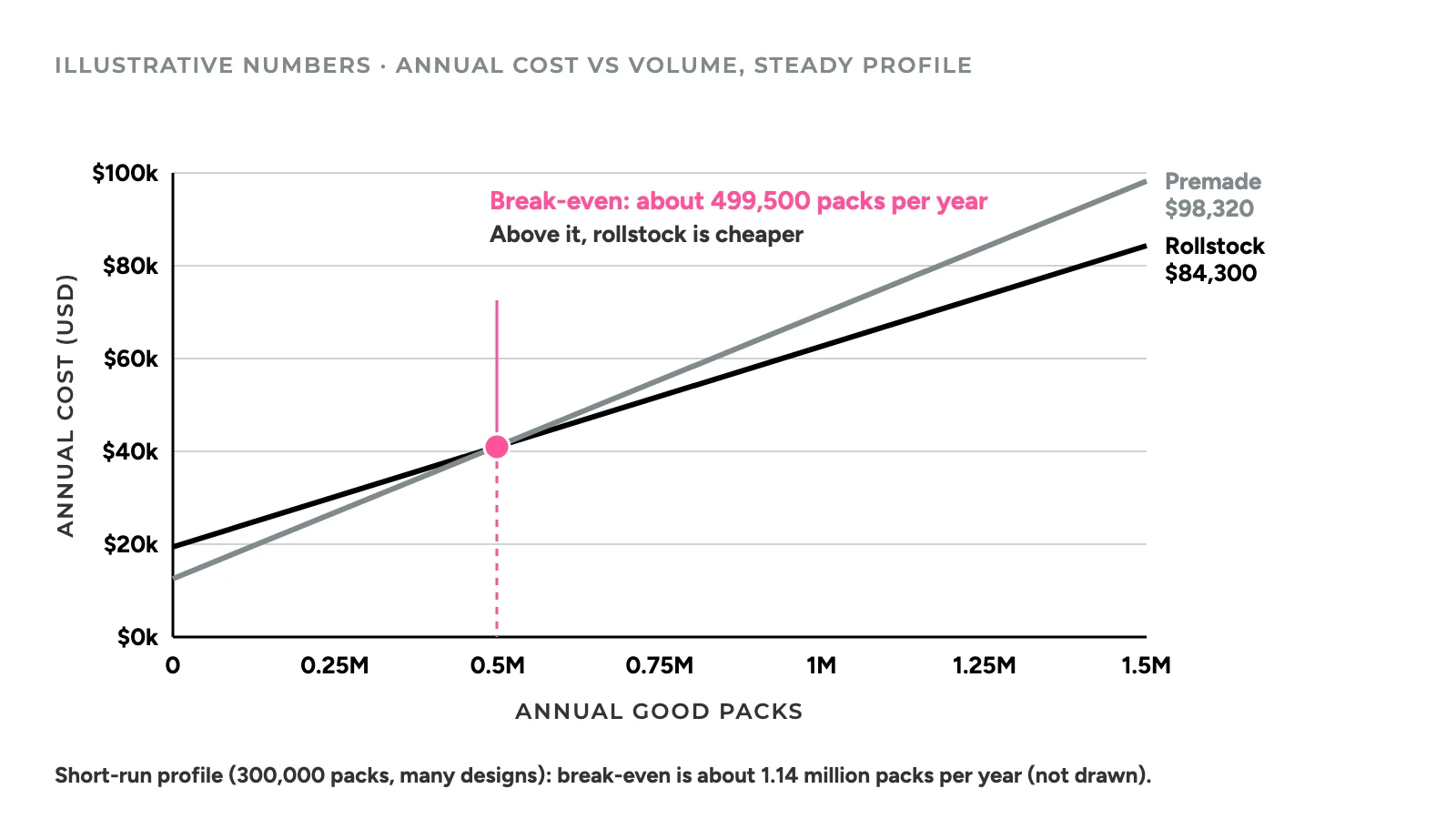
Break-even volume is where the two annual totals are equal. Fixed costs here are allocated equipment plus maintenance. Variable cost is everything else per pack: material, waste, labor and energy.
break-even packs per year
  = (annual fixed cost, rollstock - annual fixed cost, premade)
    / (variable cost per pack, premade - variable cost per pack, rollstock)
The fixed cost difference is the same in both scenarios: ($15,000 + $4,500) - ($9,000 + $3,500) = $19,500 - $12,500 = $7,000 per year.
With the steady-volume inputs, variable cost per 1,000 packs is $43.20 for rollstock ($31.20 material and waste, $10.00 labor, $2.00 energy) and $57.21 for premade ($42.63, $12.50, $2.08). The difference is $14.01 per 1,000, so break-even = $7,000 / $0.01401 per pack = about 499,500 packs per year. Above that volume, with these inputs, rollstock is cheaper.
With the short-run inputs, variable cost per 1,000 packs is $57.40 for rollstock ($37.40 material and waste, $16.67 labor, $3.33 energy) and $63.55 for premade ($45.32, $15.63, $2.60). The difference falls to $6.15 per 1,000, so break-even = $7,000 / $0.00615 per pack = about 1,138,000 packs per year.
The same pair of machines has two break-even points because waste, speed and material price depend on how the product is run. Break-even belongs to the operating profile, not to the machine alone.
Order structure and inventory
Get these figures from your own quotes rather than assuming them.
- Minimum order quantity: printed film and printed premade pouches both carry minimums, often set per design. A short run of many designs can force you to buy more than you’ll use before the artwork changes.
- Lead time: longer lead times mean holding more safety stock of printed material. Ask each supplier for lead times at your order sizes.
- Holding cost: cash tied up, warehouse space, handling and damage risk. Rolls and pouch cartons take different space and handling.
- Obsolescence: if artwork, regulatory text or a promotion changes, leftover printed film or pouches may be written off or reworked. Multiply the expected leftover by its cost for each design.
- Number of SKUs: each design adds a changeover, a stock position and an obsolescence risk. Some plants use plain film or pouches with labels or inkjet coding to cut the number of printed designs, which moves cost between lines instead of removing it.
These items often don’t show up in a machine quote or a per-unit price. Once you have estimates, add them to the model as extra material cost per 1,000 packs. For a fuller treatment of short runs, see Small Batches and Frequent Changeovers: The Hidden Cost of Packaging.
Non-price factors
Cost per good pack leaves out several things the market and the line care about.
- Shelf appeal and features: if retailers or customers expect a zipper, a spout, a stand-up base or a particular shape, the format may be settled before cost enters.
- Seal integrity: barrier needs, shelf life and leak requirements depend on the film structure and seal type, and can differ between the two routes.
- Product characteristics: powders, granules, liquids and sticky products behave differently dropped into a forming tube than into a pre-opened pouch. Dust in the seal area is one example.
- Floor space and operators: machine footprint, film storage, and your operators’ skill at threading film or loading pouch magazines all affect real speed.
Check technical fit with equipment and material suppliers, using real samples of your product and your film or pouch. A model can rank the two routes on cost, but it can’t tell you whether a pack seals or sells.
Checklist: data to collect
- Quotes for film and for finished pouches at your actual annual volume and the order sizes you would place, with minimums and lead times.
- Waste measured in trials on your product, split into setup waste and running waste.
- Speeds measured on your product with your film or pouch, changeovers included, rather than nameplate speed.
- Number of designs, expected runs per year, and what happens to leftover printed material.
- Installed cost quotes for both machines with the same scope, plus an assumed life.
- Operators needed, the loaded labor rate, and energy and maintenance records or estimates.
Keep reading
- Small Batches and Frequent Changeovers: The Hidden Cost of Packaging: read this if your runs are short, since run length and changeover time drive the waste and speed inputs used here.
- The True Installed Cost of Packaging Automation: it lists what belongs in the installed equipment figure you allocate in this comparison.
- Manual, Semi-Automatic or Fully Automatic Packaging? A Cost Model: the same break-even logic applied to the level of automation.
More cost models sit under Production Economics.
Assumptions and limits
- Your material prices, speeds, waste rates and labor costs will differ from these, and the ranking can change with them.
- Waste is a share of net material and is held constant within each scenario. Real waste varies by film, product and operator.
- The equipment allocation is straight-line, for comparison only. Financing, taxes, residual value, the time value of money and ramp-up are left out.
- Inventory carrying cost, minimum-order surplus and obsolescence are described but not priced in the worked tables.
- Labor and maintenance are simplified to one operator per machine and a flat annual maintenance amount.
- The model compares routes on cost. Food-contact, safety and engineering questions need their own review.