 WonksAnonymous

CapEx Budget Template for Manufacturing Equipment: Line Items Most Requests Leave Out
Structure a manufacturing equipment CapEx budget request with separate rows for rigging, electrical and air utilities, SKU tooling, FAT/SAT, and contingency.
A manufacturing equipment CapEx budget template must itemize every physical cost driver from the vendor’s loading dock to accepted production on its own row. Approving a capital request on the OEM machine quote alone leaves freight, rigging, utility drops, changeover tooling, and startup scrap unfunded, forcing mid-project supplemental requests or startup delays.
Under the U.S. Environmental Protection Agency (EPA) Air Pollution Control Cost Manual (Chapter 2, Section 2.6.4.1), vendor equipment quotations are generally F.O.B. (free-on-board) the vendor and exclude taxes, freight, and site charges. In our packaging automation installed-cost analysis, an $80,000 machine quote requires $37,500 across six non-machine cost groups to reach a $117,500 total installed cost, extending simple payback at a $24,000 annual net cash benefit from 40 months to 58.75 months (about 59 months). Use this guide alongside the Automation Investment reading guide to structure a plant-level Capital Expenditure Request (CapEx Request or Authorization for Expenditure) before routing quotes for financial sign-off.
Updated October 28, 2026.
Why corporate FP&A CapEx templates fail on manufacturing equipment
Corporate finance CapEx templates track annual departmental asset totals, whereas a plant equipment request must fund the complete physical installation and startup scope. Treating a departmental rollup sheet as an engineering project budget hides site preparation, utility tie-ins, and startup losses inside a single lump-sum cell.
Generic spreadsheet templates from Limelight Software and Template.net organize capital budgets as schedules for fixed-asset purchases, while You Exec and Smartsheet focus on corporate financial ratios or high-level project summaries. None of those generic layouts separate rigging, electrical workspace clearances, compressed air distribution drops, multi-SKU format tooling, Factory Acceptance Testing (FAT), or estimate-class contingency reserves.
Under Title 13 of the United States Code, the U.S. Census Bureau Annual Capital Expenditures Survey (ACES) defines business capital expenditures as spending during the year for new and used structures and equipment chargeable to asset accounts for which depreciation or amortization accounts are ordinarily maintained. The National Institute of Standards and Technology (NIST) Applied Economics Office groups manufacturing capital investments across four categories: procurement of machinery and equipment, construction of facilities and structures, employee training and education, and research and development. From the project owner’s viewpoint, the U.S. EPA Air Pollution Control Cost Manual (Chapter 2, Section 2.4.1) defines Total Capital Investment (TCI) as the sum of purchased equipment costs, direct installation costs, site preparation, buildings, indirect installation costs, land, working capital, and off-site facilities.
Scroll horizontally to see all columns.
| Budget Document Type | Primary Scope & Granularity | Treatment of Installation & Startup | Core Failure Mode on Factory Equipment |
|---|---|---|---|
| Corporate FP&A CapEx Rollup (e.g., Limelight Software, Template.net) | Annual organization-level schedule of fixed-asset purchases | Collapses the entire machine purchase into a single line item from the vendor quote | Excludes rigging, electrical/pneumatic upgrades, format change parts, and startup scrap |
| Multi-tab DCF / Valuation Sheet (e.g., You Exec Capital Budgeting Spreadsheet) | Models IRR, WACC, CAPM, and adjusted basis across editable sheets | Assumes the Year 0 capital outlay figure is already complete and verified | Understates the investment denominator when fed an F.O.B. machine price instead of Total Capital Investment |
| Plant Equipment Appropriation Request (TCI / AFE Line-Item Template) | One row per physical cost driver across purchased equipment, direct installation, indirect startup, and contingency | Tags each row as PP&E Capital, Supplies Inventory, or Project OpEx / Working Capital |
Requires FEL 2 / FEL 3 site walkdowns and itemized vendor exclusions before final lock |
Project cash authorization and accounting capitalization have different boundaries. Under External Reporting Board (XRB) / IASB Standard IAS 16 (Property, Plant and Equipment, paragraphs 16 and 17), the capitalized cost of property, plant, and equipment comprises its purchase price (including import duties and non-refundable purchase taxes, net of trade discounts and rebates) and directly attributable costs to bring the asset to the location and condition necessary for it to operate as management intended—specifically site preparation, initial delivery and handling, installation and assembly, testing whether the asset is functioning properly, and professional fees.
However, IAS 16 paragraphs 19, 20, and 22 exclude staff training costs, general administrative overhead, initial operating losses incurred while output demand builds up, relocation or reorganization costs, and abnormal amounts of wasted material or labor from the capitalized PP&E balance. If your CapEx request template deletes training, routine wear-part inventory, and post-readiness ramp-up shortfall because they are not depreciable PP&E, the plant has no approved cash budget to pay for them; keep those rows in the appropriation package and tag their accounting bucket using CapEx vs OpEx for Production Equipment.
Copy-ready manufacturing equipment CapEx budget template
Assign one row to each physical cost driver, record the trade-term or engineering basis, and tag the accounting bucket before summing the appropriation request. Every row must carry either a vendor-quoted figure, a factored pre-quote estimate, or a written reason why the cost is zero for this installation.
Before vendor freight, sales tax, or control integration quotes arrive, the U.S. EPA Air Pollution Control Cost Manual (Table 2.4, Section 2.6.4.1) provides pre-quote engineering factors (% of total equipment cost, F.O.B.): Freight ranges from 0.01 to 0.10 (typical 0.05), Sales Tax ranges from 0 to 0.08 (typical 0.03), and Instrumentation ranges from 0.05 to 0.30 (typical 0.10). EPA Section 2.6.4.1 notes that for package systems with built-in controls already included in the base equipment cost, the separate instrumentation factor in Table 2.4 is zero.
The line-item template below combines the U.S. EPA Total Capital Investment structure with the worked domestic baseline ($80,000 machine price, $117,500 total installed cost) from The True Installed Cost of Packaging Automation and the imported F.O.B. sea-freight baseline ($80,000 factory price, $97,200 landed at site, $119,500 landed and running) from Imported Equipment Costs Beyond the Factory Price. All dollar figures in the two example columns are labeled teaching demonstrations from those sibling analyses rather than market quotes.
Scroll horizontally to see all columns.
| Row ID | Cost Driver Line Item | WBS Group | Accounting Bucket Tag (IAS 16 / IRS) | Pre-Quote Basis or Engineering Check | Worked Domestic Example | Worked Imported FOB Example |
|---|---|---|---|---|---|---|
Row 1.01 |
Base machine price (F.O.B. vendor or EXW factory) | Part 1: OEM Equipment & Trade Terms | PP&E Capital (para 16(a)) |
Itemized OEM quote; verify F.O.B. vs EXW/DDP under ICC Incoterms 2020 | $80,000 |
$80,000 |
Row 1.02 |
Export crating, packing & origin inland handling | Part 1: OEM Equipment & Trade Terms | PP&E Capital (para 17(c)) |
Included in seller FOB price ($1,500 crating + $2,000 origin freight/loading in imported example) |
$0 |
$3,500 |
Row 1.03 |
Main carriage, cargo insurance, port charges & inland freight | Part 1: OEM Equipment & Trade Terms | PP&E Capital (para 17(c)) |
EPA Table 2.4 Freight factor 0.01–0.10 (typical 0.05 of FOB); imported example: sea freight $4,500 + insurance $600 + port $900 + inland $1,200 |
$2,000 |
$7,200 |
Row 1.04 |
Customs brokerage, import duties & non-refundable sales tax | Part 1: OEM Equipment & Trade Terms | PP&E Capital (para 16(a)) |
EPA Table 2.4 Sales Tax 0–0.08 (typical 0.03); imported example: brokerage $500 + import duties/taxes $6,000 |
$0 |
$6,500 |
Row 1.05 |
Bank charges, currency allowance & warranty shipping reserve | Part 1: OEM Equipment & Trade Terms | Project OpEx / Commercial Reserve |
Imported example: bank/currency allowance ($1,500) + warranty part shipping reserve ($1,000) |
$0 |
$2,500 |
Row 2.01 |
Dock unloading, rigging skates, crane lift & placement | Part 2: Rigging & Floor Anchoring | PP&E Capital (para 17(c)/(d)) |
EPA Sec. 2.4.1 direct handling/erection & Sec. 2.6.4.2 tight-fit/JIT off-loading | $1,500 |
$1,500 |
Row 2.02 |
Concrete slab core-drilling, plinth & fixed-machine anchoring | Part 2: Rigging & Floor Anchoring | PP&E Capital (para 17(b)/(d)) |
Mandatory fixed-location anchoring under OSHA 1910.212(b) |
$800 |
$0 |
Row 2.03 |
Existing rack, conveyor & aisle relocation (layout changes) | Part 2: Rigging & Floor Anchoring | Assess per Policy (para 20(c)) |
EPA Sec. 2.6.4.2 retrofit relocation of existing production equipment | $1,700 |
$0 |
Row 3.01 |
Electrical feeder, lockable disconnect & fault-current compliance | Part 3: Plant Utilities | PP&E Capital (para 17(d)) |
OSHA 1910.303(b)(4)–(5), (f)(4) lockable disconnect & Table S-1 clearances (imported example local compliance $3,000) |
$1,800 |
$3,000 |
Row 3.02 |
Compressed air dryer, filter-regulator & branch piping drop | Part 3: Plant Utilities | PP&E Capital (para 17(d)) |
U.S. DOE Tip Sheet #1 capacity check & ASTM B241 (AW-6060 T51 / AW-6063 T5) aluminum piping |
$1,200 |
$0 |
Row 3.03 |
Process water, drainage or dust/fume extraction tie-in | Part 3: Plant Utilities | PP&E Capital (para 17(d)) |
EPA Sec. 2.4.1 direct piping & utility tie-in check ($0 when dry process requires none) |
$0 |
$0 |
Row 4.01 |
Upstream infeed & downstream discharge conveyor integration | Part 4: Tooling, Integration & Safety | PP&E Capital (para 17(d)) |
Mechanical transfer plates, guide rails, and elevation matching | $3,500 |
$0 |
Row 4.02 |
Checkweigher, date coder & auxiliary equipment interfaces | Part 4: Tooling, Integration & Safety | PP&E Capital (para 17(d)) |
Mounting brackets, reject mechanism, and signal handshakes | $1,500 |
$0 |
Row 4.03 |
PLC controls integration, line-stop & fault interlocks | Part 4: Tooling, Integration & Safety | PP&E Capital (para 17(d)) |
EPA Table 2.4 Instrumentation 0.05–0.30 (typical 0.10, or 0 if built-in); ISA FEL 2 and FEL 3 scope |
$1,200 |
$0 |
Row 4.04 |
Multi-SKU changeover tooling & format change parts | Part 4: Tooling, Integration & Safety | PP&E Capital (para 9) |
Auger/funnel/agitation blade change parts per extra container size (2 extra formats in domestic example) |
$2,300 |
$0 |
Row 4.05 |
Point-of-operation guarding & interlocked safety enclosures | Part 4: Tooling, Integration & Safety | PP&E Capital (para 17(d)) |
OSHA 1910.212(a)(1)–(5) guarding & interlocked enclosures |
$1,200 |
$0 |
Row 5.01 |
Factory Acceptance Test (HFAT/SFAT) travel & sample shipping | Part 5: FAT/SAT, Commissioning & Training | PP&E Capital (para 17(e)) |
ISA HFAT/SFAT witness testing & All-Fill 20–30 sample weight checks |
$1,300 |
$0 |
Row 5.02 |
Site Acceptance Test (SAT), validation protocols & documentation | Part 5: FAT/SAT, Commissioning & Training | PP&E Capital (para 17(e)) |
EPA Sec. 2.4.1 start-up and performance test costs; plant SAT/validation practice ($500 SAT + $1,000 validation in domestic example) |
$1,500 |
$0 |
Row 5.03 |
Vendor commissioning engineer days, travel & waiting allowance | Part 5: FAT/SAT, Commissioning & Training | PP&E Capital (para 17(d)) |
Domestic example: 5 days at $1,000/day ($5,000); imported example: 5 days at $900 ($4,500) + $5,000 travel + $1,000 waiting + $800 remote support |
$5,000 |
$11,300 |
Row 5.04 |
Operator & maintenance staff training (allocated separately) | Part 5: FAT/SAT, Commissioning & Training | Project OpEx (para 19(c)) |
Excluded from PP&E equipment cost under IAS 16 para 19(c); expense as received | $1,200 |
$0 |
Row 6.01 |
Pre-readiness setup & trial packaging materials / product | Part 6: Trial Stock, Spares & Ramp-Up | Assess per Policy (para 17(e)) |
EPA Sec. 2.4.1 Start-Up component; IAS 16 para 20A P&L recognition of test output/cost | $1,300 |
$0 |
Row 6.02 |
Initial spare parts split: standby capital modules vs. wear parts | Part 6: Trial Stock, Spares & Ramp-Up | PP&E vs. Supplies Inventory (para 8) |
Separate rotable/standby spares (excluded from IRS $2,500/$5,000 safe harbor) from routine belts/seals |
$1,500 |
$4,000 |
Row 6.03 |
Installation downtime, post-readiness ramp-up shortfall & internal engineering | Part 6: Trial Stock, Spares & Ramp-Up | Project OpEx / Working Capital (para 20(b)) |
Domestic example: $1,500 lost production + $2,500 ramp-up shortfall + $3,000 internal staff time ($7,000 total) |
$7,000 |
$0 |
Row 7.01 |
Estimate-class & contract-vehicle contingency reserve | Part 7: Contingency Reserve | Unallocated Capital Reserve |
EPA Sec. 2.6.4.2: 5%–15% of TCI for mature tech; owner sets aside on cost-plus lines |
Sized by class |
Sized by class |
| Total | Total Project Appropriation Request (Pre-Contingency Baseline) | Parts 1–6 | Capital + Inventory + Project OpEx | Sum of Rows 1.01 to 6.03 | $117,500 |
$119,500 |
Line items most equipment requests leave out
1. Trade terms, oversized transport, staging, and floor anchoring
Trade terms allocate freight invoices between seller and buyer, but no trade term covers plant-side unloading, tight-fit rigging, or floor anchoring. Published by the International Chamber of Commerce (ICC) and effective 1 January 2020, Incoterms 2020 defines eleven three-letter trade terms—including EXW (Ex Works), FOB (Free on Board), CIF (Cost, Insurance and Freight), DAP (Delivered at Place), and DDP (Delivered Duty Paid)—that allocate transport legs, customs clearance, and risk transfer between sellers and buyers.
In the imported equipment cost breakdown, an $80,000 factory-price machine requires $17,200 in export crating ($1,500), origin freight ($2,000), sea freight ($4,500), cargo insurance ($600), port charges ($900), customs brokerage ($500), import duties ($6,000), and inland delivery ($1,200) to reach $97,200 landed at the plant dock, plus $22,300 in plant-side costs that no Incoterm removes to reach $119,500. Moving the contract from EXW ($80,000 paid to the seller, $39,500 paid separately by the buyer) to FOB ($83,500 to seller, $36,000 separate) or DDP ($97,200 to seller, $22,300 separate) shifts the logistics invoices without reducing the $22,300 of plant-side work by a dollar.
Once the truck reaches the plant, the U.S. EPA Air Pollution Control Cost Manual (Section 2.6.4.2) lists six considerations that might be used when developing a retrofit factor (including Lost Production, typically treated with indirect start-up rather than as a separate CapEx line); the remaining considerations are:
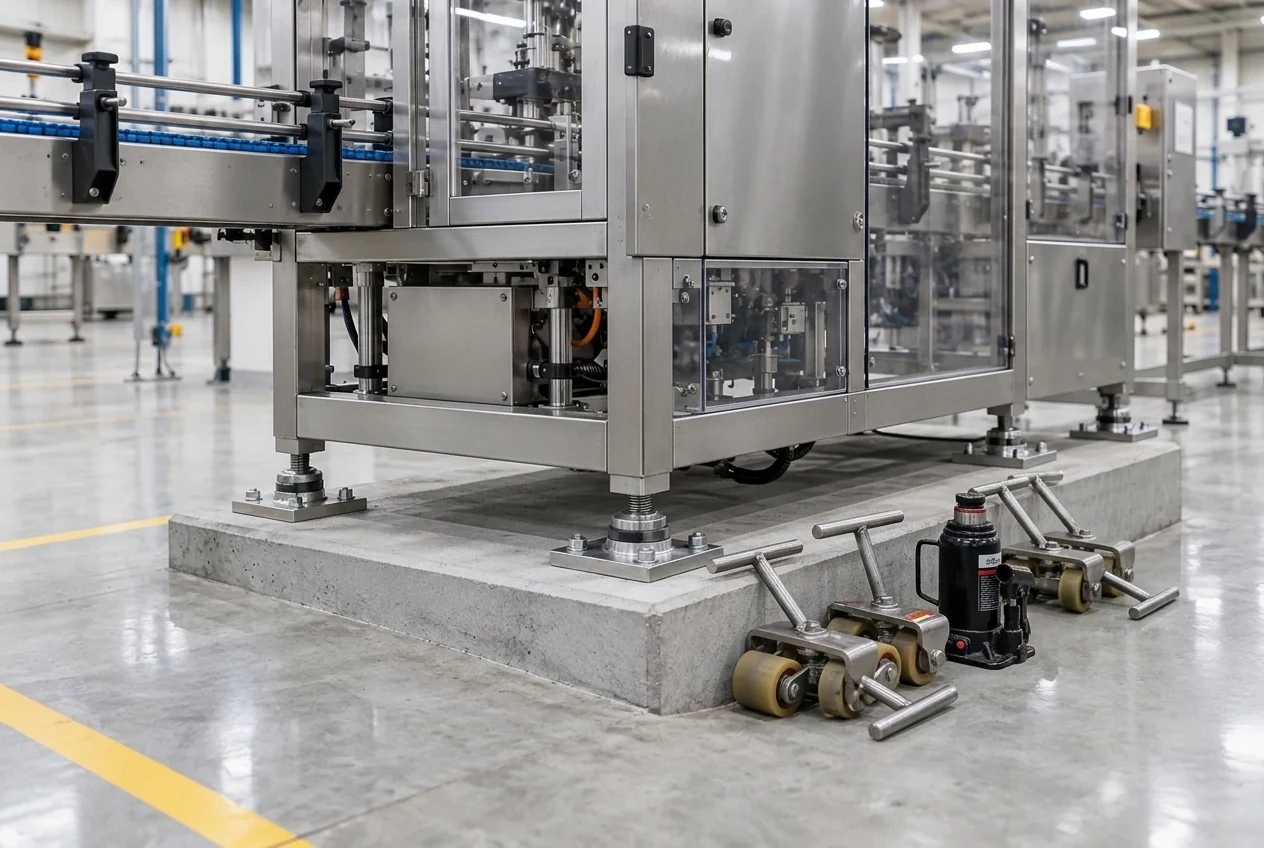
- Tight-fit handling and erection: Special unloading, transport, and placement care required to thread machinery into congested existing bays.
- Site preparation and equipment relocation: Surveying, leveling, and relocating existing production equipment, racks, or conveyors to clear the footprint.
- Off-site utility and storage interfaces: Connecting to external plant utility headers or transport staging points is typically not a major source of retrofit costs under EPA Off-Site Facilities guidance.
- Limited staging space and Just-In-Time (JIT) off-loading: Small plant yards that cannot store crated machinery require either off-site/fabricator space rental fees or JIT delivery for direct off-loading from the carrier straight to the installation foundation.
- Route transportation clearances: Road bearing limits, bridge overpass height restrictions, oversized shipment permits, special escorts, and non-traffic or weekend-only transit windows.
At the machine footprint, U.S. Occupational Safety and Health Administration (OSHA) regulation 1910.212(b) mandates that machines designed for a fixed location shall be securely anchored to prevent walking or moving. Your CapEx budget template must carry a dedicated line (Row 2.02) for concrete core-drilling, chemical or expansion anchor bolts, or pouring an isolated concrete plinth.
2. Electrical fault-current ratings, workspace clearances, and compressed air drops
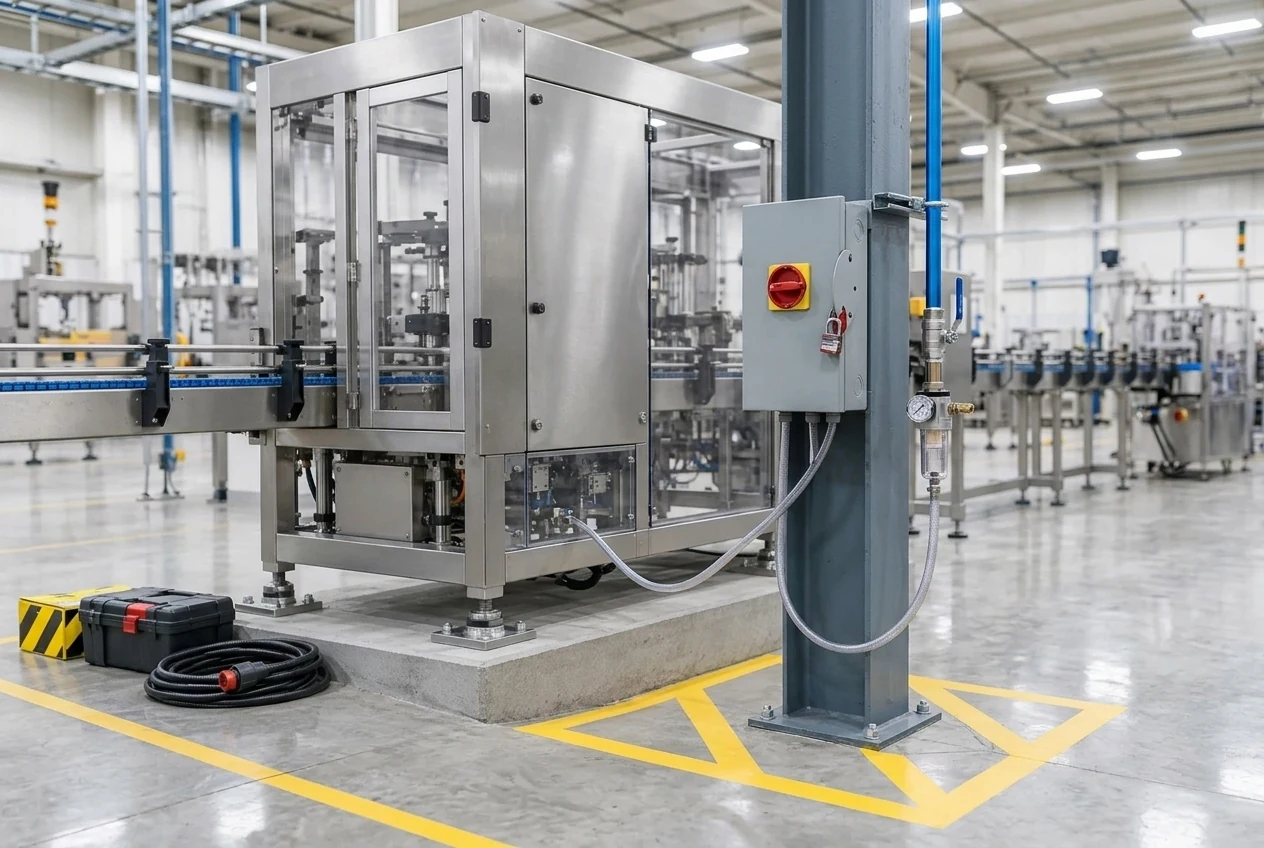
Connecting a machine to plant utilities requires verifying breaker fault-current interrupting ratings, OSHA working clearances, and compressed air header pressure drop before locking the budget. Assuming an existing breaker panel or compressed air branch line can absorb a new automated line is a primary source of unbudgeted contractor change orders.
On the electrical side, OSHA standard 1910.303 enforces four hardware and layout constraints that directly affect installation cost (Row 3.01):
- Listed installation (
1910.303(b)(2)): Listed or labeled electrical equipment must be installed and used in accordance with instructions included in the listing or labeling. - Fault-current interrupting rating and SCCR coordination (
1910.303(b)(4)and(b)(5)): Equipment intended to interrupt current at fault levels must have an interrupting rating sufficient for the nominal circuit voltage and available fault current at the line terminals, and overcurrent protective devices, total circuit impedance, and component short-circuit current ratings (SCCR) must be coordinated to clear a fault without extensive damage. - Disconnect purpose marking and lockable open position (
1910.303(f)(1)–(2)and(f)(4)): Each disconnecting means for motors and appliances, and each service, feeder, or branch circuit at its disconnecting means or overcurrent device, must be legibly marked to indicate its purpose ((f)(1)–(2)), and disconnecting means required by the subpart must be capable of being locked in the open position ((f)(4)). - Working space and dedicated overhead space (
1910.303(g)(1)andTable S-1): For equipment operating at600 V, nominal, or less, the working space width in front of the enclosure must be at least762 mm (30 in.)or the width of the equipment (whichever is greater) and permit at least a90-degreedoor opening; minimum headroom for installations built on or after August 13, 2007 is1.98 m (6.5 ft); dedicated indoor electrical space free of foreign piping or ducts must extend1.83 m (6.0 ft)above the equipment; and minimum clear front working depth underTable S-1for151–600 Vto ground is0.9 m (3.0 ft)under Condition A,1.0 m (3.5 ft)under Condition B, and1.2 m (4.0 ft)under Condition C (0.9 m / 3.0 ftacross all three conditions for0–150 Vto ground).
On the pneumatic side, the U.S. Department of Energy (DOE) Compressed Air Tip Sheet #1 reports that compressed air accounts for approximately 10% (and up to 30% or more) of industrial electricity consumption, operates at an overall system efficiency as low as 10%–15%, and that approximately 7 to 8 hp of electrical power is supplied to the air compressor to drive a 1-hp air motor at 100 psig. In DOE’s 10-year lifetime cost analysis of a 75-hp compressor operated two shifts a day, five days a week at $0.05/kWh, electricity accounts for 76% of total cost, equipment for 12%, and maintenance for 12%.
As documented by Compressed Air Best Practices, pressure drop—measured in pounds per square inch differential (PSID)—forces compressors to work harder, whereas lowering system discharge pressure by 2 psi yields approximately 1% energy savings. Specifying modular distribution piping extruded from aluminum grades AW-6060 T51 or AW-6063 T5 under ASTM B241 uses smooth-bore full-flow fittings that minimize friction and turbulence; in a Texas aerospace plant installation reported by Compressed Air Best Practices, replacing a 4-inch U-shaped main specification with a 2 1/2-inch closed-loop modular aluminum header reduced piping material cost by over 40% and installation time by 25%.
3. Multi-SKU changeover tooling, machine guarding, and FAT/SAT verification
Extra SKU change parts, line-interface guarding, and Factory Acceptance Testing (FAT) belong on separate budget rows from the base machine quote. When comparing supplier proposals using Comparing Packaging Machinery Quotes on a Like-for-Like Basis, verify every format and test requirement before signing the purchase order.
- Per-format changeover tooling (
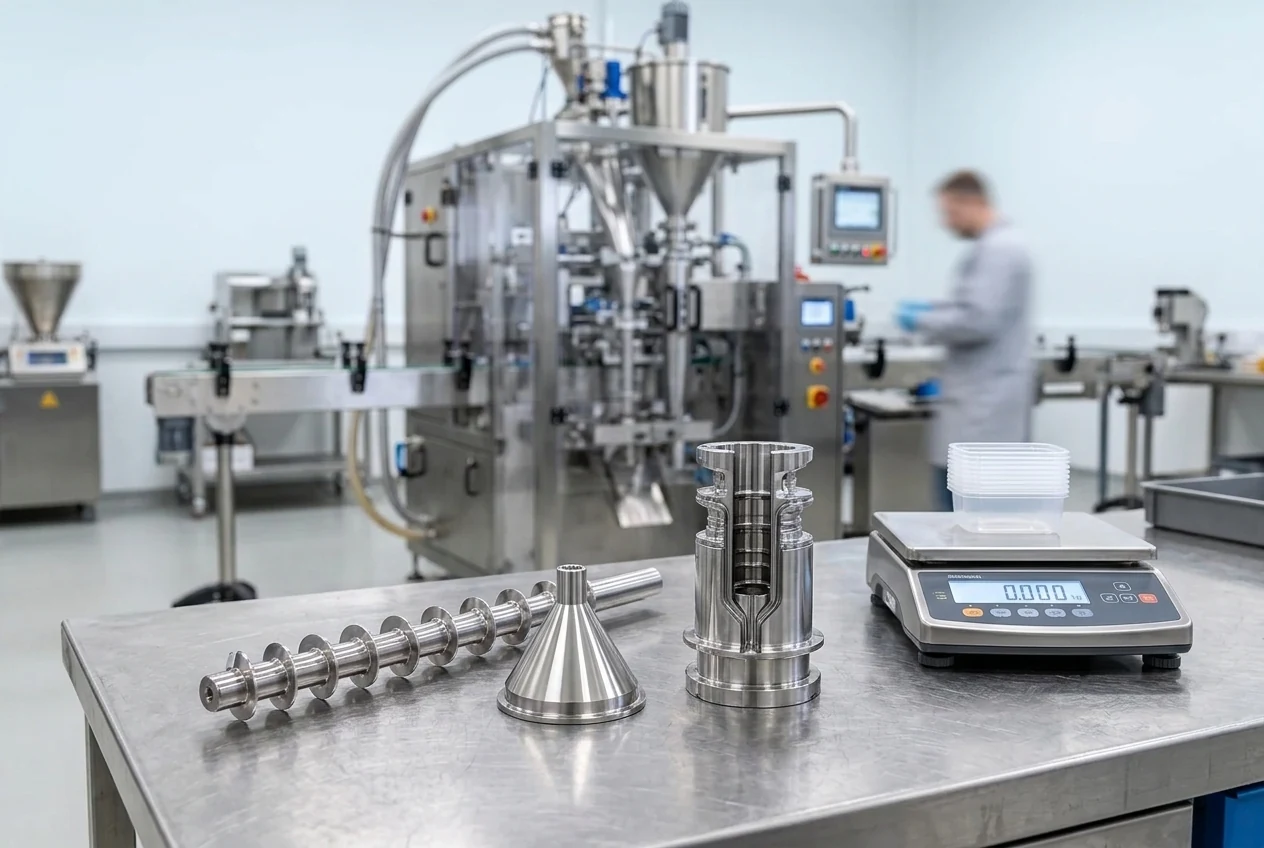
Row 4.04): U.S. packaging machinery manufacturer All-Fill Inc. discusses format tooling sizes—such as the auger, funnel, and agitation blade—available in its Test Labs when diagnosing whether a tooling set is ideal for the machine and product. Under IAS 16 paragraph 9, individually insignificant moulds, tools, and dies may be aggregated for PP&E recognition; in our domestic installed-cost example, change parts for two additional pack sizes add$2,300(Row 4.04). - Point-of-operation and interlocked guarding (
Row 4.05): OSHA1910.212(a)(1)and(a)(3)require machine guarding to protect operators and other employees from hazards created by point of operation, ingoing nip points, and rotating parts;1910.212(a)(4)requires revolving drums, barrels, and containers to be guarded by an enclosure interlocked with the drive mechanism so the drum cannot revolve unless the guard enclosure is in place; and1910.212(a)(5)requires fan blades less than7 feetabove the floor to have guard openings no larger than1/2 inch. - Hardware and Software Factory Acceptance Testing (
Row 5.01): As documented in the International Society of Automation (ISA) InTech guide on Factory Acceptance Testing, bypassing or rushing the FAT shifts engineering mistakes to the plant floor, where operations personnel, trades contractors, technicians, and engineers are on hand and workers are standing ready (with system component manufacturers also onsite). ISA specifies two distinct pre-shipment verification stages:- Hardware FAT (HFAT): Visual inspection of control panels for completeness and cleanliness, ground bonding checks, short-circuit isolation checks, and—where
UL 508Ais specified—verification that fusing amperage and terminal torque requirements are identified inside the enclosure, components areULandFMapproved, and theUL 508Acertification label is adhered inside the panel. - Software FAT (SFAT): Powering up the system to verify primary and redundant power supply and PLC failover operation, testing all digital inputs and outputs with temporary switches or jumpers, and confirming analog inputs with a current simulator signaling
4 mA, 12 mA, and 20 mAwhile witnessing the corresponding0%, 50%, and 100%values in the control code. - Product and tooling run at the OEM (
All-Fill Inc.): All-Fill Inc. uses the FAT to show that the machine can achieve the quoted accuracy and rate (cpm); separately, its Test Lab procedure takes20 to 30sample weights on an offline scale to determine standard deviation and confirm accuracy when evaluating tooling with the customer’s product.
- Hardware FAT (HFAT): Visual inspection of control panels for completeness and cleanliness, ground bonding checks, short-circuit isolation checks, and—where
- Spare parts and tax safe-harbor split (
Row 6.02): Under IAS 16 paragraph 8, spare parts, stand-by equipment, and servicing equipment are recognized as PP&E when they meet the definition of PP&E, and otherwise are classified as inventory. Under U.S. Internal Revenue Service (IRS) Tangible Property Final Regulations andNotice 2015-82(effective January 1, 2016), the federal tax de minimis safe harbor election covers items up to$2,500per invoice or item without an Applicable Financial Statement (AFS) or$5,000per invoice or item with an AFS, and explicitly excludes inventory, land, and rotable, temporary, and standby emergency spare parts.
Sizing contingency reserves by estimate class and contract vehicle
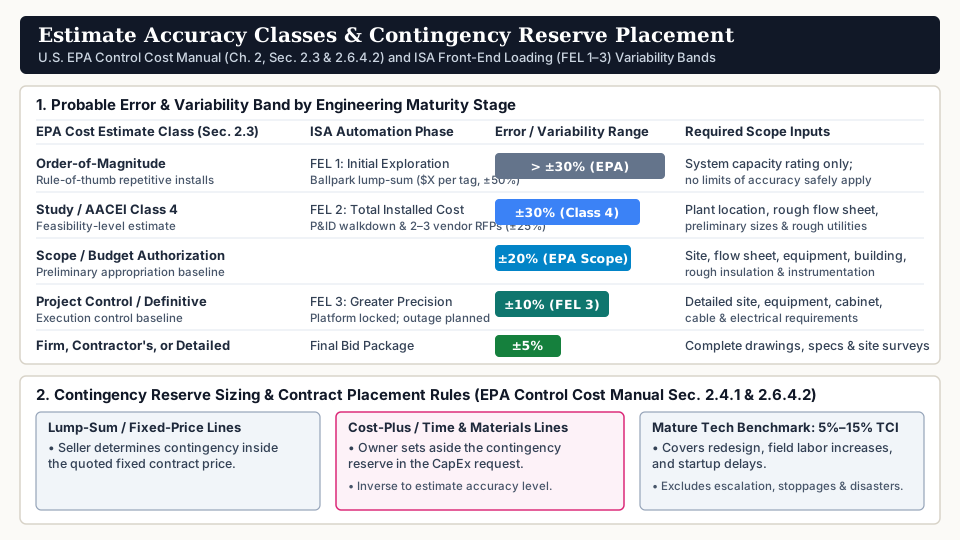
Contingency is inversely proportional to the accuracy of your cost estimate and depends on whether each scope package is contracted as lump-sum or cost-plus. Applying a single flat percentage across an entire CapEx request either starves preliminary utility estimates or pads signed fixed-price machine quotes.
In the U.S. EPA Air Pollution Control Cost Manual (Chapter 2, Section 2.4.1), contingencies cover unforeseen project costs within the defined scope—such as possible redesign and modification of equipment, increases in field labor costs, and delays encountered in start-up—and the same section states that escalation is not treated as part of contingencies. EPA Section 2.6.4.2 states that for mature technologies, overall project contingency ranges from 5% to 15% of Total Capital Investment (TCI), that contingency is not the same thing as uncertainty or existing-plant retrofit factors, and that contingency should not account for macroeconomic price escalation, work stoppages, or disasters.
Furthermore, EPA Section 2.6.4.2 establishes that contingency placement differs by contract vehicle: under lump-sum / fixed-price contracts, the seller determines the contingency allowances (which are reflected inside the quoted contract price), whereas under cost-plus (cost-reimbursable) contracts, the owner determines and sets aside the contingency amount.
Combining the five EPA / AACEI cost estimate classifications (Section 2.3) with the three ISA InTech Front-End Loading (FEL 1, FEL 2, and FEL 3) automation project phases defines the exact accuracy band for each row of your CapEx template:
Scroll horizontally to see all columns.
| Estimate Maturity Stage | EPA / AACEI Classification (Sec. 2.3) |
ISA Automation Phase (InTech) |
Required Engineering & Procurement Deliverables | Probable Error / Variability Band | Contingency & Governance Rule |
|---|---|---|---|---|---|
| Stage 1: Concept / Screening | Order-of-Magnitude (repetitive plant installations with cost history) | FEL 1: Initial Exploration | System capacity rating or rule-of-thumb ($X per tag) only; minimal internal meetings |
> ±30% (EPA; Perry’s notes no limits of accuracy safely apply) / ±50% (ISA FEL 1) |
Use only to screen whether to fund FEL 2 (plant practice: avoid locking a final CapEx appropriation on FEL 1 accuracy alone) |
| Stage 2: Feasibility / Study | Study Estimate / AACEI Class 4 | FEL 2: Fleshing Out the Picture (TIC) |
Plant location, rough flow sheet / P&ID walkdown, preliminary sizes, rough utility estimates, and 2–3 vendor RFP quotes |
±30% (EPA Study / AACEI Class 4) / ±25% (ISA FEL 2 Total Installed Cost) |
Preliminary capital plan; consider contingency toward the upper end of the EPA mature-tech TCI range when estimate accuracy is lower, or release to FEL 3 |
| Stage 3: Budget Authorization | Scope, Budget Authorization, or Preliminary | Between FEL 2 and FEL 3 deliverables (ISA names FEL 1–3 only) | Site knowledge, flow sheet, equipment quotes, building scope, and rough insulation and instrumentation specs | ±20% (EPA Scope / Budget Authorization) |
Editorial plant practice: common gate for a formal CapEx Request / AFE once EPA Scope (±20%) deliverables exist |
| Stage 4: Project Control / Definitive | Project Control or Definitive | FEL 3: Greater Precision | Platform vendor locked in; detailed site, equipment, electrical, individual cabinet/cable inspections, and outage schedule | ±10% (EPA Definitive & ISA FEL 3 Total Installed Cost) |
Definitive execution budget for conservative finance teams or multi-year, multi-plant rollouts |
| Stage 5: Firm / Detailed Bid | Firm, Contractor’s, or Detailed | Final Bid Package | Complete drawings, specifications, and site surveys right before construction | ±5% (EPA Firm / Detailed) |
Signed fixed-price vendor/contractor lines where seller embeds contingency in the lump-sum price |
Connecting the CapEx budget sheet to your Excel ROI and cash-flow model
Your CapEx budget template provides the Year 0 investment outlay and Year 1 ramp-up adjustment that feed a multi-year discounted cash-flow spreadsheet. Feeding an incomplete machine-only figure into an Excel NPV or ROI sheet overstates project returns and understates the payback period.
Under the NIST Smart Investment Tool guide (AMS 200-5: A Guide to Evaluating the Economic Feasibility of Manufacturing Investments, Section 2.1), net present value (NPV) analyses use the firm’s hurdle or weighted average cost of capital (WACC) discount rate—or, when the rate is uncertain, a discount rate range such as 9% to 12% or Monte Carlo sensitivity analysis.
In our Packaging Automation Installed Cost worked example with a constant $24,000 annual net cash benefit over 5 years ($120,000 total net benefit), replacing the $80,000 machine quote with the $117,500 total installed cost changes the financial metrics as follows:
Total 5-year net cash benefit = 5 x $24,000 = $120,000

5-year ROI on machine price alone  = ($120,000 - $80,000) / $80,000   = 0.50   (50%)
5-year ROI on total installed cost = ($120,000 - $117,500) / $117,500 = 0.021  (about 2%)

Simple payback on machine price    = $80,000 / $24,000   = 3.33 years = 40 months
Simple payback on installed cost   = $117,500 / $24,000  = 4.90 years = 58.75 months (about 59 months)
When building a multi-year sheet in Build a Multi-Year Equipment Cash-Flow Model in Excel (or adding milestone deposits and 7-year MACRS tax shields in ROI Calculation in Excel: Simple ROI, Discounted Payback, NPV, XNPV, IRR, and MIRR for Equipment CapEx), map the subtotals from your CapEx budget template directly into the cash-flow columns without double-counting:
- Year 0 Capital Cash Flow (
Cell D4): Enter the negative sum of all one-time pre-production capital and startup outlays required to reach normal operation (-$80,000in the simplified five-year Excel cash-flow demonstration, or-$117,500/-$119,500from the full installed and imported tables above). - Year 1 Operating Cash Flow (
Cell C5): In the five-year Excel sheet (2026-01-01to2031-01-01), Year 1 operating cash flow is$8,000during ramp-up (followed by$22,000in Year 2,-$6,000in Year 3 during an overhaul,$24,000in Year 4, and$24,000operating plus$10,000residual cash =$34,000in Year 5). Keep the ramp-up shortfall in one place only: if you already included the$2,500ramp-up shortfall inside the initial investment (Row 6.03in the domestic installed-cost example), do not subtract that same$2,500a second time from Year 1 operating cash flow. - Excel NPV and XNPV Formulas (
=D4+NPV(B1,E5:E9)): Because Microsoft Excel’sNPVfunction discounts values starting one period after the investment begins, add the Year 0 capital outlay (D4) outsideNPV(B1,E5:E9)(which equals-$17,713.59at an8%demonstration rate in the five-year Excel sheet, compared with-$16,401.47ifE4is mistakenly placed insideNPV(B1,E4:E9), and-$17,721.18using=XNPV(B1,E4:E9,B4:B9)across exact calendar dates including the 2028 leap year).
Pre-approval CapEx budget verification checklist
Before submitting the Capital Appropriation Request to finance, verify these eight items across engineering, purchasing, and accounting:
- Every row has a quote, a factor, or a written zero: Every row across Parts 1–7 carries a supplier quote, an EPA Table 2.4 pre-quote factor, or a documented engineering reason why the line is zero.
- Trade terms and plant-side scope are separated: The contract Incoterms 2020 rule (
EXW,FOB,CIF,DAP, orDDP) is stated onRow 1.01, and dock unloading, rigging, local compliance, and engineer days (Rows 2.01–5.03) remain budgeted regardless of the trade term. - Floor anchoring and guarding meet OSHA machine rules: Fixed-location anchoring (
Row 2.02) and point-of-operation / interlocked guarding (Row 4.05) are scoped to satisfyOSHA 1910.212(a)and(b). - Electrical fault-current rating and clearances are verified on site: Available fault current, breaker interrupting rating, lockable disconnects, and
Table S-1working depth (3.0 ft,3.5 ft, or4.0 ftfor151–600 Vto ground) are confirmed underOSHA 1910.303. - Compressed air peak flow and pressure drop are sized: Compressor/dryer headroom and branch piping (
ASTM B241aluminum loop vs. drop) are checked so pneumatic actuators do not starve at peak cycle speed. - Every planned SKU format has changeover tooling priced: Extra augers, funnels, forming tubes, or sealing jaws (
Row 4.04) are itemized for every container size beyond the base reference format, and20–30sample fills are scheduled for the FAT (Row 5.01). - Mixed invoices are split by accounting bucket: Commissioning engineer days (
Row 5.03), operator training (Row 5.04), standby spares vs. routine wear parts (Row 6.02), and ramp-up reserves (Row 6.03) are tagged separately for PP&E, inventory, and Project OpEx underIAS 16and company policy. - Post-installation audit date is scheduled: The approved line-item table is saved as the baseline for The 90-Day Post-Installation Review after startup.
Frequently asked questions
What is the difference between a CapEx budget template and an equipment appropriation request?
A corporate CapEx budget template (such as those from Limelight Software or Template.net) is an annual organization-level schedule listing fixed-asset purchases as single summary rows. Smartsheet’s business budget templates cover high-level project and department budgets, not CapEx fixed-asset schedules. An equipment Capital Appropriation Request (or Authorization for Expenditure) decomposes a single project into its complete Total Capital Investment (TCI) under the U.S. EPA Air Pollution Control Cost Manual—separating base F.O.B. equipment, freight, rigging, foundations, electrical and compressed air utilities, format tooling, FAT/SAT testing, startup reserves, and contingency.
How much contingency should a manufacturing CapEx budget include?
Under the U.S. EPA Air Pollution Control Cost Manual (Chapter 2, Section 2.6.4.2), contingency is inversely proportional to estimate accuracy and ranges from 5% to 15% of Total Capital Investment (TCI) for mature technologies. Study-level feasibility estimates and cost-plus field installation contracts require an owner-held contingency reserve set aside by the buyer, whereas signed lump-sum / fixed-price vendor equipment contracts already embed the seller’s contingency allowance inside the quoted contract price.
Do operator training and spare parts belong in a CapEx budget template?
Yes—include them on separate rows so the project cash outflow is authorized, but tag their accounting buckets accurately. Under IAS 16 paragraph 19(c), staff training is excluded from capitalized PP&E equipment cost and recognized as an operating expense (Row 5.04). Under IAS 16 paragraph 8, major standby or rotable spares that meet the PP&E definition are capitalized (and are excluded from the IRS $2,500 / $5,000 de minimis safe harbor under Notice 2015-82), whereas routine wear parts like belts and seals enter supplies inventory (Row 6.02).
How does a CapEx budget template connect to an Excel ROI template?
The sum of one-time capital and pre-production startup rows from your CapEx budget template becomes the negative Year 0 capital cash-flow cell (D4) in your Excel ROI and NPV model, sitting outside Excel’s =D4+NPV(B1,E5:E9) formula. Using the full $117,500 installed cost instead of the $80,000 machine quote on a project with $24,000 in annual net cash savings changes 5-year simple ROI from 50% to 0.021 (about 2%) and moves simple payback from 40 months to 58.75 months (about 59 months).